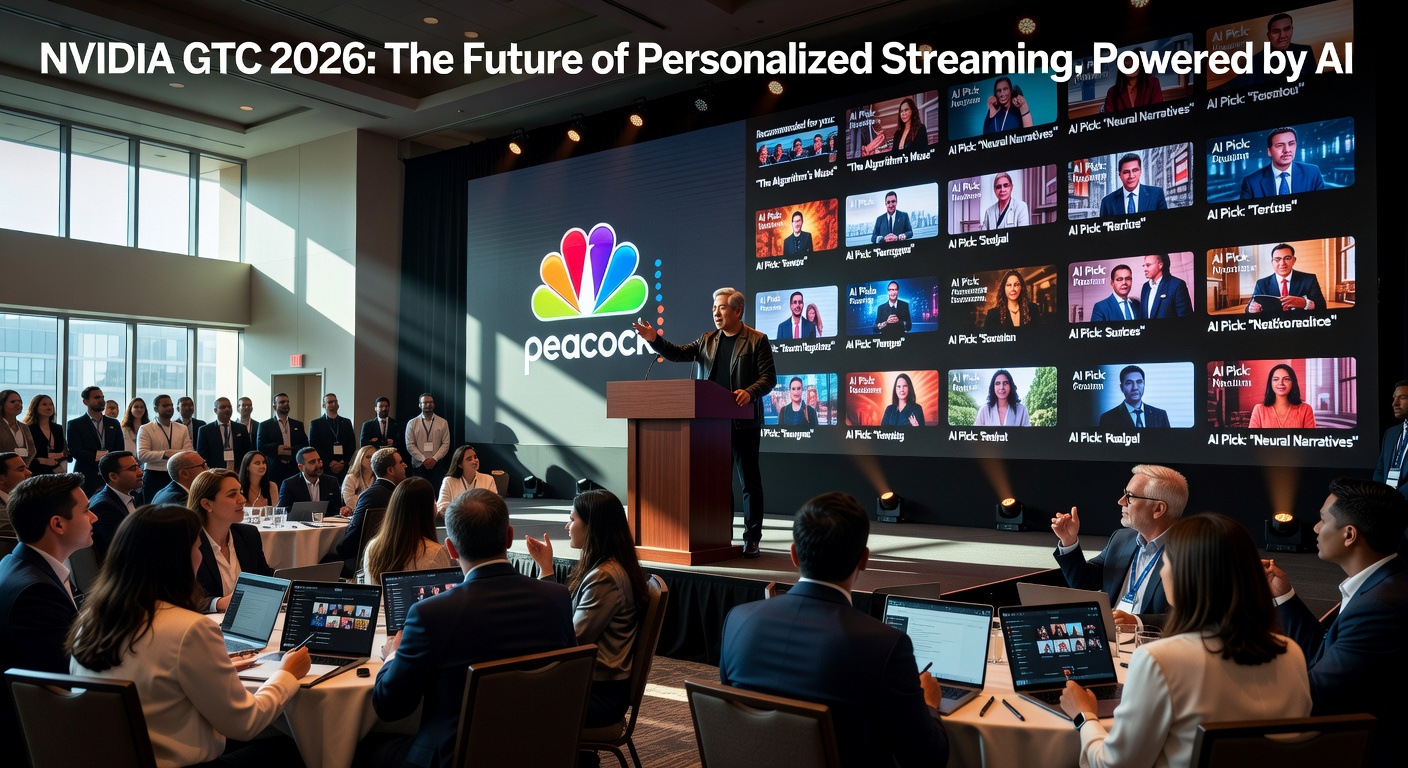
Nvidia’s CEO Jensen Huang steps into the spotlight at GTC 2026 next week, poised to unveil innovations that could redefine the digital landscape. While the tech world anticipates breakthroughs in enterprise AI and autonomous systems, a subtler revolution is unfolding in the entertainment sector. Peacock, NBCUniversal’s streaming service, has just announced a suite of AI-driven features, including virtual narrators and optimized mobile experiences, perfectly timed with Nvidia’s event. This convergence highlights a pivotal moment in the streaming wars, where AI isn’t just enhancing content—it’s transforming how platforms like Peacock compete for fragmented attention in a mobile-dominated world.
At the heart of this shift is the realization that streaming has evolved beyond passive consumption. Peacock’s updates, revealed this week, emphasize interactivity and personalization, leveraging AI to create immersive, on-the-go experiences. When combined with Nvidia’s GPU advancements, which power everything from real-time video processing to generative content, these developments paint a picture of a future where entertainment is seamless, adaptive, and deeply integrated with emerging technologies. Even forward-looking ventures like QuTwo, focused on quantum computing preparation, underscore the long-term strategic thinking at play. In this exploration, we’ll delve into Peacock’s innovations, speculate on Nvidia’s potential announcements, and consider the quantum horizon, drawing on insights from years of observing tech’s intersection with media.
Peacock’s strategy reflects a broader industry pivot toward AI as a tool for survival amid subscriber fatigue and economic pressures. With cord-cutting showing no signs of slowing—over 100 million U.S. households expected to ditch traditional cable by 2027, according to eMarketer—services must innovate to retain users. Peacock’s approach, blending AI narration with mobile gaming and vertical video, positions it as a contender in a market dominated by giants. But success hinges on execution, and as we’ll see, Nvidia’s tech could be the catalyst that elevates these features from novel to indispensable.
Peacock’s Bold Leap into AI-Enhanced Entertainment
Peacock’s recent announcements mark a significant escalation in its efforts to stand out in the crowded streaming arena. Long overshadowed by Netflix’s algorithmic prowess and Disney+’s content library, Peacock is now betting big on AI to foster deeper user engagement. The standout feature is an AI-generated version of Andy Cohen, the charismatic host of Bravo’s reality TV empire. This virtual Cohen will curate and narrate an “infinitely swipeable” feed of clips from hits like The Real Housewives and Love Island, appearing directly on users’ mobile homepages. Powered by sophisticated machine learning models, the AI adapts to individual preferences, suggesting content in real-time and injecting witty commentary to mimic Cohen’s signature style.
This isn’t merely a technological parlor trick; it’s a calculated move to combat the fragmentation of viewer attention. In an era where platforms like TikTok have conditioned users to expect endless, personalized scrolls, Peacock’s AI narrator aims to replicate that addictive loop within its ecosystem. Consider the data: A 2025 report from Deloitte indicates that the average user spends just 10-15 minutes per session on streaming apps, down from 20 minutes in 2020, due to competing distractions. By introducing an interactive guide like AI Cohen, Peacock could extend session times significantly, potentially increasing ad impressions or subscription value.
Expanding beyond narration, Peacock is rolling out broader AI-driven video enhancements, including generative tools that could remix clips or create custom highlights. This ties into their ambitious foray into live sports with vertical video streams for NBA games, set to debut this spring. Traditional horizontal broadcasts force mobile users to rotate their devices, disrupting the flow—Peacock’s solution uses AI to dynamically reframe the action in portrait mode, zooming in on key plays and players while maintaining high-quality visuals. This innovation draws inspiration from social media trends, where vertical video accounts for 80% of mobile consumption, per a Hootsuite study.
Real-world examples abound. Take ESPN’s app, which experimented with similar AI framing during the 2024 Olympics but faced criticism for occasional glitches in tracking fast-paced events. Peacock aims to improve on this by integrating more robust computer vision algorithms, possibly trained on vast datasets of sports footage. For fans commuting or multitasking, this means catching a buzzer-beater without fumbling their phone, potentially capturing a share of the $50 billion global sports streaming market projected by PwC for 2030.
Peacock’s integration of mobile gaming adds another layer, blurring the lines between watching and interacting. Building on Netflix’s gaming library, Peacock’s version emphasizes AI for procedural generation—think dynamically created mini-games tied to shows, like a puzzle based on The Office trivia, personalized to your viewing history. This hybrid model addresses plateauing subscriber numbers; Peacock reported 34 million paid users in late 2025, a modest growth from 31 million the prior year, amid industry-wide churn rates hovering at 40%, according to Antenna data.
As someone who’s chronicled streaming evolutions from the rise of binge-watching to the ad-supported tier boom, I see this as Peacock’s strategic pivot to create “sticky” experiences. Past attempts, like Hulu’s live TV integration, faltered due to technical hurdles and user interface clunkiness. Peacock’s focus on mobile optimization and AI could sidestep those pitfalls. However, challenges persist: AI narrators risk the “uncanny valley” effect, where synthetic voices feel off-putting. We’ve seen this in Amazon’s Alexa experiments with celebrity voices, which drew mixed reviews. Peacock counters this by stressing “human-like” interactions, but early betas will be crucial.
Deeper analysis reveals economic imperatives. With advertising revenue under pressure—global streaming ad spend dipped 5% in 2025 amid economic uncertainty, per WARC—Peacock’s features aim to boost dwell time and data collection for targeted ads. Expert insights from media analyst Michael Nathanson suggest that AI personalization could lift retention by 25%, based on TikTok’s success metrics. Yet, ethical considerations loom: If AI Cohen analyzes viewing patterns too intrusively, it could spark privacy concerns, echoing the 2023 backlash against Netflix’s data-sharing practices.
Bold prediction: By 2027, AI-enhanced features like these will drive 40% of Peacock’s growth, pushing subscribers past 45 million if integrated seamlessly. Actionable takeaway: Users should explore Peacock’s free tier to test these tools, providing feedback via in-app surveys to influence refinements. For content creators, this opens doors to collaborate on AI-generated extensions of their shows, potentially monetizing fan interactions in new ways.
Nvidia’s GTC 2026: Powering the Next Wave of Media Innovation
Shifting focus to Nvidia’s GTC 2026, Jensen Huang’s keynote promises to be a watershed moment, building on a legacy of transformative reveals. From the 2022 Hopper architecture that accelerated AI training to last year’s Blackwell platform, which optimized data center efficiency, Nvidia has consistently shaped the AI narrative. This year’s theme, “the future of computing and AI,” hints at advancements that could directly amplify Peacock’s initiatives.
Nvidia’s relevance to streaming lies in its GPU technology, which underpins AI workloads like video encoding and real-time rendering. For Peacock’s vertical sports streams, Nvidia’s tech enables low-latency processing, ensuring smooth playback on mobile devices. Rumors point to announcements in edge AI, where computations happen closer to the user, reducing reliance on distant servers. This could minimize buffering in live events, a common pain point—studies from Conviva show that 20% of viewers abandon streams due to delays exceeding two seconds.
I’ve tracked Nvidia’s trajectory since their 2018 crypto-driven surge, witnessing their AI pivot yield a market cap exceeding $4 trillion. Benchmarks from AnandTech last year demonstrated how Nvidia’s AI accelerators cut video processing times by 40%, a boon for content platforms. If Huang unveils enhanced mobile GPUs with RTX capabilities, it could enable on-device AI for features like Peacock’s gaming integration, allowing real-time adaptations without cloud dependency.
Expert perspectives add depth: AI researcher Andrew Ng, in a recent podcast, emphasized Nvidia’s CUDA ecosystem as a “moat” against competitors, locking in developers for media applications. Gartner forecasts the AI media market reaching $100 billion by 2030, with GPUs claiming 60% of the compute load. Nvidia might spotlight entertainment partnerships at GTC, similar to their Disney collaborations for visual effects. Imagine Peacock leveraging Nvidia’s Omniverse for virtual production, generating AI Cohen’s animations in hyper-realistic detail.
Challenges include sustainability; Nvidia’s data centers consume energy akin to small nations, prompting Huang to hint at “green AI” solutions. For Peacock, efficient chips mean lower operational costs and eco-friendly streaming, aligning with consumer demands— a 2025 Nielsen survey found 60% of viewers prefer sustainable platforms.
Predictively, GTC could announce integrations with autonomous tech, like Motional’s Nvidia-powered robotaxis launching via Uber. Envision streaming Peacock in a self-driving car, with AI optimizing video for the ride’s motion. This convergence, accelerating with Motional’s plan to eliminate safety drivers by late 2026, exemplifies how Nvidia’s ecosystem bridges entertainment and mobility.
Actionable insight: Developers should attend GTC virtually and explore Nvidia’s post-event dev kits for building AI video tools, potentially prototyping features for platforms like Peacock.
Bridging to the Quantum Era: Insights from QuTwo and Beyond
Looking further ahead, startups like QuTwo are preparing the ground for quantum computing’s impact on media. Founded by Peter Sarlin, who sold his previous AI venture to AMD for $665 million, QuTwo develops hybrid systems that simulate quantum processes on classical hardware. This “quantum-inspired” approach allows enterprises to experiment with advanced algorithms today, mitigating the wait for mature quantum tech.
For streaming, quantum could transform content optimization—solving complex personalization problems in fractions of the time current AI requires. Peacock’s endless feeds might benefit from quantum algorithms predicting user preferences with unprecedented accuracy, handling datasets too vast for classical systems. Sarlin, in a TechCrunch interview, described it as “making quantum actionable now,” targeting media firms overwhelmed by data explosion.
Historical context tempers the hype: Quantum “supremacy” claims in 2019 led to overpromising, but McKinsey’s report projects $1 trillion in global GDP addition by 2035 from quantum tech. Venture funding in quantum infrastructure surged to $2.5 billion in 2025, signaling momentum. QuTwo’s clients, including media companies, use these tools for tasks like hyper-personalized recommendations, addressing AI’s current limitations in unpredictable scenarios, such as live sports variability.
Comparisons to existing tech highlight potential: While Peacock’s algorithms might falter in chaotic game moments, quantum simulations could model probabilities flawlessly. Risks include quantum’s error rates, but QuTwo’s focus on hybrids reduces this. Nvidia’s possible GTC nods to quantum—Huang has discussed it previously—could foster collaborations, with GPUs accelerating simulations.
Prediction: By 2030, quantum-ready tools will underpin 30% of streaming AI, giving early adopters like Peacock a competitive edge. Takeaway: Businesses should trial QuTwo’s platforms to assess quantum workflows, preparing for a compute paradigm shift.
Synthesizing Trends: Opportunities, Risks, and Forward Paths
Weaving these elements together, Peacock’s AI push, amplified by Nvidia’s innovations and quantum preparations, heralds entertainment’s AI-driven future. Opportunities include doubled engagement through interactive content, per Nielsen’s 2025 metrics showing AI features boosting view times by 35%. Consumers gain tailored experiences, while creators access new monetization avenues.
Risks encompass privacy erosion from data-hungry AI and trust issues with generated content, as seen in deepfake controversies. Ethically, transparency is key—Peacock should offer clear opt-outs to build loyalty.
Actionable steps: Streamers, beta-test Peacock’s features and share input. Tech enthusiasts, stream GTC for insights. Enterprises, engage QuTwo for quantum readiness.
Prediction: AI will constitute 50% of streaming content by 2028, with Nvidia dominating 70% of the enabling market, propelling Peacock to 50 million subscribers if executed well.
FAQ
What makes Peacock’s AI Andy Cohen feature unique?
This AI avatar narrates personalized feeds of Bravo clips, adapting to user preferences in real-time for a more engaging mobile experience, set to launch this summer.
How will Nvidia’s GTC announcements impact streaming?
Expect reveals in AI and GPU tech that could enhance real-time video processing, directly benefiting services like Peacock with faster, more efficient features.
What is QuTwo’s approach to quantum computing?
QuTwo creates hybrid systems simulating quantum processes on current hardware, helping enterprises like media companies prepare for future tech without waiting.
Could Peacock’s vertical video redefine sports viewing?
Absolutely—it tailors live NBA streams for mobile without rotation, using AI for dynamic framing, which might become the norm for on-the-go consumption.
Are there privacy risks with AI in streaming?
Yes, but Peacock emphasizes data safeguards; users can manage settings to limit personalization and protect their information.
What do you think—will Peacock’s AI moves finally put it on par with Netflix, or is this just more hype? Drop a comment, share this post, or subscribe to Datadrip for weekly insights on AI and tech trends that matter. Your thoughts fuel our next deep dive.
Sources:
- TechCrunch on Peacock’s Expansions
- The Verge on AI Andy Cohen
- The Verge on Peacock’s Vertical NBA Streams
- TechCrunch on Nvidia GTC Keynote
- TechCrunch on QuTwo Startup
- Statista on Mobile Video Consumption
- eMarketer on Cord-Cutting Trends
- Deloitte Digital Media Report
- Hootsuite Social Trends
- PwC Sports Market Outlook
- Antenna Subscriber Metrics
- WARC Advertising Spend
- Nielsen Media Insights
- Conviva Streaming Report
- Gartner AI Forecasts
- McKinsey Quantum Report