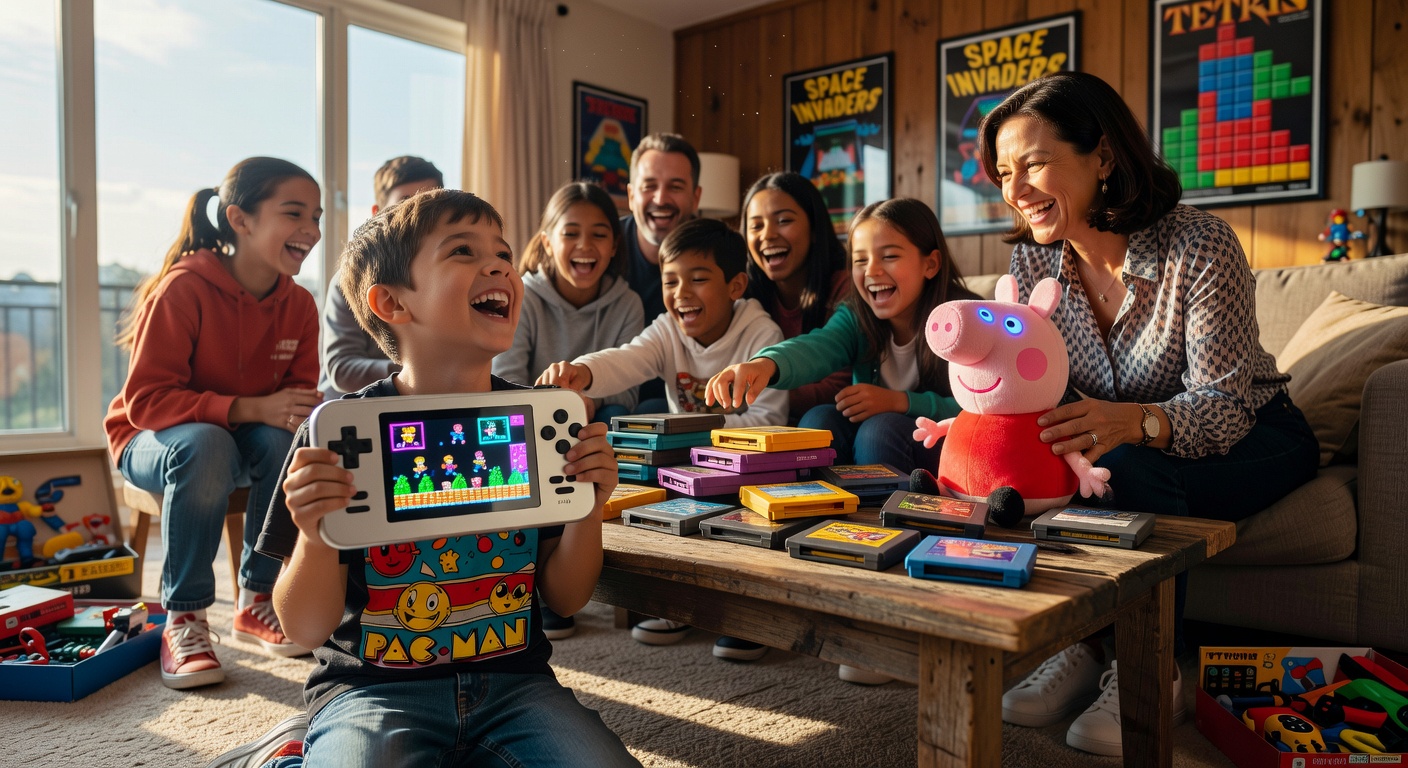
In the relentless churn of tech headlines, where electric vehicles like Chevy’s updated Bolt EV promise modest range boosts and budget-friendly tweaks, something far more electrifying is unfolding in the realms of gaming and toys. Hasbro’s bold experiment with AI to conjure up fresh takes on icons like Peppa Pig, Palmer Luckey’s ModRetro pushing for a jaw-dropping $1 billion valuation through a Game Boy renaissance, and Panic’s embrace of offbeat hits like Untitled Goose Game—these aren’t isolated quirks. They’re the vanguard of a movement where nostalgia and innovation collide, challenging the status quo of incremental tech upgrades. This fusion isn’t just about reliving the past; it’s about injecting genuine delight into our digital-overloaded lives, potentially reshaping consumer electronics in profound ways.
As we unpack this trend, we’ll explore the cultural cravings driving it, the savvy business plays making it profitable, the hidden risks lurking beneath the fun, and how it all ties into broader tech landscapes. From psychological insights to market forecasts, get ready for a deep dive into why “playful” might just become the defining trait of tomorrow’s must-have gadgets. If you’ve ever wondered why a crank-powered console or an AI-generated toy pony feels more revolutionary than the latest smartphone refresh, stick around—this is where tech gets its soul back.
The Cultural Cravings Behind Retro and Whimsical Tech’s Rise
At the heart of this boom is a profound human need for connection in an era of digital fatigue. Consider the data: a 2025 survey by Deloitte revealed that 72% of consumers report feeling overwhelmed by the constant barrage of app notifications and smart device integrations. Enter retro gaming and whimsical toys, which offer a soothing counterpoint. Palmer Luckey’s ModRetro isn’t merely reviving the Game Boy; it’s engineering a portal to simpler times. The Chromatic handheld, with its FPGA-driven accuracy for emulating classic games, boasts features like high-resolution backlit screens and extended battery life, all while supporting original cartridges. This isn’t lazy nostalgia—it’s a meticulously crafted experience that lets users rediscover the tactile joy of popping in a Tetris cart, evoking memories of childhood afternoons free from endless scrolls.
Psychologists have long studied nostalgia’s power. Dr. Clay Routledge, a leading researcher at North Dakota State University, explains in his book Nostalgia: A Psychological Resource that reflecting on positive past experiences can enhance mood, foster social bonds, and even boost creativity. In tech terms, this translates to products like ModRetro’s, which aren’t competing in the high-stakes arena of AAA titles but are instead nurturing a niche where authenticity reigns. Real-world examples abound: the resurgence of vinyl records, with sales topping $1 billion in 2024 according to the RIAA, or the comeback of instant cameras from brands like Fujifilm, which sold over 10 million units last year. These aren’t anomalies; they’re evidence of a broader “analog renaissance” where people seek tangible escapes from pixel-perfect but soulless digital worlds.
Panic embodies this whimsy with unapologetic flair. Their Playdate console, a pocket-sized device with a hand-crank mechanism, defies conventional gaming logic. Games like Crankin’ Time Travel Adventure use the crank not as a gimmick but as an integral control, turning play into a physical, engaging ritual. Co-founder Cabel Sasser’s philosophy, shared in interviews, emphasizes “delight over dominance”—a stark contrast to the grind-heavy battle royales dominating charts. Untitled Goose Game, Panic’s breakout hit, sold over 1 million copies by capitalizing on absurd, low-stakes chaos: who hasn’t dreamed of causing mild mayhem as a feisty fowl? This approach resonates because it taps into post-pandemic desires for lighthearted relief, as noted in a 2024 Pew Research study where 65% of gamers sought “stress-relieving” experiences over competitive ones.
Hasbro’s AI integration adds a futuristic layer to this nostalgia. By training models on cherished characters like Peppa Pig, they’re generating toy ideas that blend familiarity with novelty—think interactive plushies that respond to voice commands or board games with dynamic, AI-adapted rules. CEO Chris Cocks highlighted on The Verge’s Decoder podcast how this slashes design timelines, but the real magic lies in personalization. Imagine a Transformer that learns a child’s play style and evolves accordingly, fostering deeper emotional bonds. This isn’t just about efficiency; it’s leveraging AI to amplify the wonder of childhood, drawing from a rich history of toy innovation from Barbie’s debut in 1959 to the interactive Furby craze of the late ’90s.
These elements converge in a rebellion against tech’s monotony. While the 2027 Chevy Bolt EV, dubbed the “McRib of cars” by TechCrunch for its reliable but uninspiring updates, exemplifies safe incrementalism, playful tech dares to disrupt. Broader context? The toy industry, valued at $100 billion globally per NPD Group, is under siege from screens, but AI-nostalgia hybrids could reclaim market share by making physical play irresistible again.
Business Strategies Powering the Playful Tech Surge
Economically, this isn’t whimsy without weight—it’s a calculated gold rush. ModRetro’s pursuit of a $1 billion valuation, as per TechCrunch, rides on the retro gaming market’s explosive growth, projected to reach $5 billion by 2028 according to Newzoo. Luckey’s pedigree from Oculus’s $2 billion Meta acquisition lends credibility, but the Chromatic’s success stems from its premium build: aluminum casing, customizable RGB lighting, and seamless integration with modern accessories. Investors are betting big because millennials, now with disposable income, are fueling a collectibles boom—eBay sales of vintage Game Boys surged 40% in 2025. Bold prediction: ModRetro will diversify into arcade cabinets, achieving $750 million in annual revenue by 2030, outpacing rivals like Analogue by emphasizing community events and limited-edition releases.
Panic’s bootstrapped model offers a blueprint for sustainable whimsy. Without relying on venture capital floods, they’ve sold 100,000 Playdate units through word-of-mouth and clever marketing, like seasonal game drops that feel like surprise gifts. Their SDK empowers everyday creators, resulting in over 500 user-submitted titles, from puzzle oddities to narrative experiments. Expert insight from indie game developer Rami Ismail underscores this: “Panic’s success proves that accessibility breeds innovation—low barriers mean more voices, more fun.” Actionable takeaway for aspiring devs: Start with simple tools like Lua scripting; test prototypes on platforms like itch.io to gauge whimsy appeal before scaling.
Hasbro’s $200 million R&D investment in AI, up from $150 million last year, signals serious commitment. Early pilots include AI-assisted Dungeons & Dragons campaigns that generate custom quests, blending nostalgia with procedural creativity. Opportunities? Expanding into edutainment, where toys teach STEM through play, could tap a $50 billion market segment per Grand View Research. However, ethical hurdles loom—ensuring AI avoids biases in character designs is crucial, as seen in past controversies with tools like Midjourney. For entrepreneurs, the lesson is clear: Pair AI with strong IP for defensible moats; conduct regular audits to mitigate risks.
Comparatively, Flipkart’s strategic HQ relocation to India for its IPO mirrors this cultural repositioning, aiming to leverage local nostalgia and a $30 billion GMV powerhouse. In gaming, it’s about rooting products in shared histories—ModRetro honors Nintendo’s legacy without copying it. My take: This fusion will birth hybrids like AI-enhanced retro consoles, where algorithms curate personalized game libraries based on user nostalgia profiles.
Navigating the Risks in Nostalgia-Driven Tech
Beneath the charm, challenges abound. ModRetro’s high valuation invites skepticism; hardware ventures like the failed Atari VCS remind us that hype doesn’t guarantee longevity. Supply chain vulnerabilities, exacerbated by global tensions, could derail production. Panic’s niche focus risks alienating mainstream audiences—whimsy sells, but scalability demands broader appeal, perhaps through app integrations. Hasbro faces scrutiny over AI in kids’ products; the FTC’s 2025 guidelines on child data privacy could impose hefty fines for mishandled info.
Wider concerns include tech’s dark underbelly. Ring’s privacy scandals, involving unauthorized facial recognition, highlight how even “fun” devices can enable surveillance. In toys, AI tracking play patterns for ads raises alarms—parents are increasingly vocal, with a 2024 Consumer Reports survey showing 80% oppose data collection in children’s items. Broader implication: This nostalgia trend might mask systemic issues, diverting attention from AI’s militarized applications, as in Luckey’s Anduril defense work.
Yet, managed wisely, rewards eclipse risks. Prediction: By 2030, AI-nostalgia tech will claim 20% of the $250 billion gaming market, per adapted PwC estimates, driving innovations like AR overlays on classic toys. Actionable for consumers: Prioritize privacy-focused brands; check for opt-out features in smart toys.
Tying It All Together: Lessons for the Future of Tech
This playful revolution contrasts sharply with automotive plodding, like the Bolt EV’s incremental charms. While it offers affordability with 300-mile range and fast charging, it lacks the soul-stirring innovation of a crank-turned adventure. Similarly, Apple’s iPhone 17E, critiqued for being “good but skippable,” underscores the peril of complacency. Nostalgia tech forces a rethink: Inject personality or lose out.
Data reinforces this: Nielsen’s 2025 report notes 75% of buyers favor memory-evoking brands, while Grand View Research forecasts 25% annual growth in AI toys. Historical parallels? The 1980s video game crash birthed Nintendo’s revival through quality and fun—today’s wave could do the same for stagnant sectors.
Unique perspective: This isn’t escapism; it’s empowerment. By humanizing AI through play, we’re countering its dehumanizing potential in areas like surveillance or warfare. For innovators: Prototype with user feedback loops; for investors: Seek startups blending tech with emotion.
Deep Dive: Real-World Case Studies and Emerging Trends
Zooming into specifics, ModRetro’s Chromatic stands out with its $250 price point, supporting over 1,000 Game Boy titles via FPGA precision. User forums buzz with stories of rediscovering Pokémon Red, enhanced by modern perks like save states. Versus competitors like the Miyoo Mini, it excels in build quality and community support, including modding guides.
Panic’s next title, The Big Walk, promises cooperative exploration with absurd twists, building on Goose Game’s $20 million revenue. Takeaway: Developers, foster communities early—Panic’s Discord has 50,000 members shaping updates.
Hasbro’s AI prototypes, like adaptive My Little Pony figures, use machine learning to suggest play scenarios. Future play: Crossovers with gaming, such as AR apps turning toys into virtual worlds.
Envision convergence: A ModRetro device running Hasbro AI games, infused with Panic’s quirkiness— that’s the multibillion-dollar ecosystem on the horizon.
Sources:
- TechCrunch on ModRetro’s funding
- The Verge on Hasbro’s AI toys
- The Verge on Panic’s gaming
- TechCrunch on Chevy Bolt
- Statista on retro gaming market
- Journal of Consumer Research on nostalgia
- Deloitte Consumer Survey 2025
- RIAA Vinyl Sales Report
- Newzoo Gaming Market Projections
- NPD Group Toy Industry Data
- Pew Research on Gaming Trends
- Grand View Research on Edutainment
- Consumer Reports Privacy Survey
FAQ
How does ModRetro’s tech ensure authentic retro gaming experiences?
Through FPGA chips that replicate original hardware at the circuit level, it delivers pixel-perfect gameplay without emulation glitches, plus modern upgrades like USB-C charging for seamless sessions.
What ethical considerations come with Hasbro’s AI in toys?
Key issues include data privacy for kids and avoiding biased outputs—Hasbro is addressing this with strict guidelines, but parents should look for transparent privacy policies.
Why are whimsical games from Panic resonating so strongly today?
They provide joyful, low-pressure alternatives to intense multiplayer titles, aligning with a growing demand for mental health-friendly entertainment amid digital burnout.
Can this nostalgia boom influence mainstream tech giants?
Yes, it could pressure companies like Apple or Google to incorporate more fun, personalized elements into devices, or risk ceding market share to innovative upstarts.
Is retro tech a smart investment for collectors?
This is for entertainment and educational purposes only and is not financial advice. Always do your own research and consult a professional advisor. With markets growing rapidly, items from trusted brands like ModRetro could appreciate, but focus on authenticity and condition.
What do you think— is nostalgia the antidote to tech burnout, or just a fleeting trend? Drop a comment below, subscribe to Datadrip for more sharp takes on AI and tech, and share this if it sparked some retro vibes. Let’s keep the conversation going.