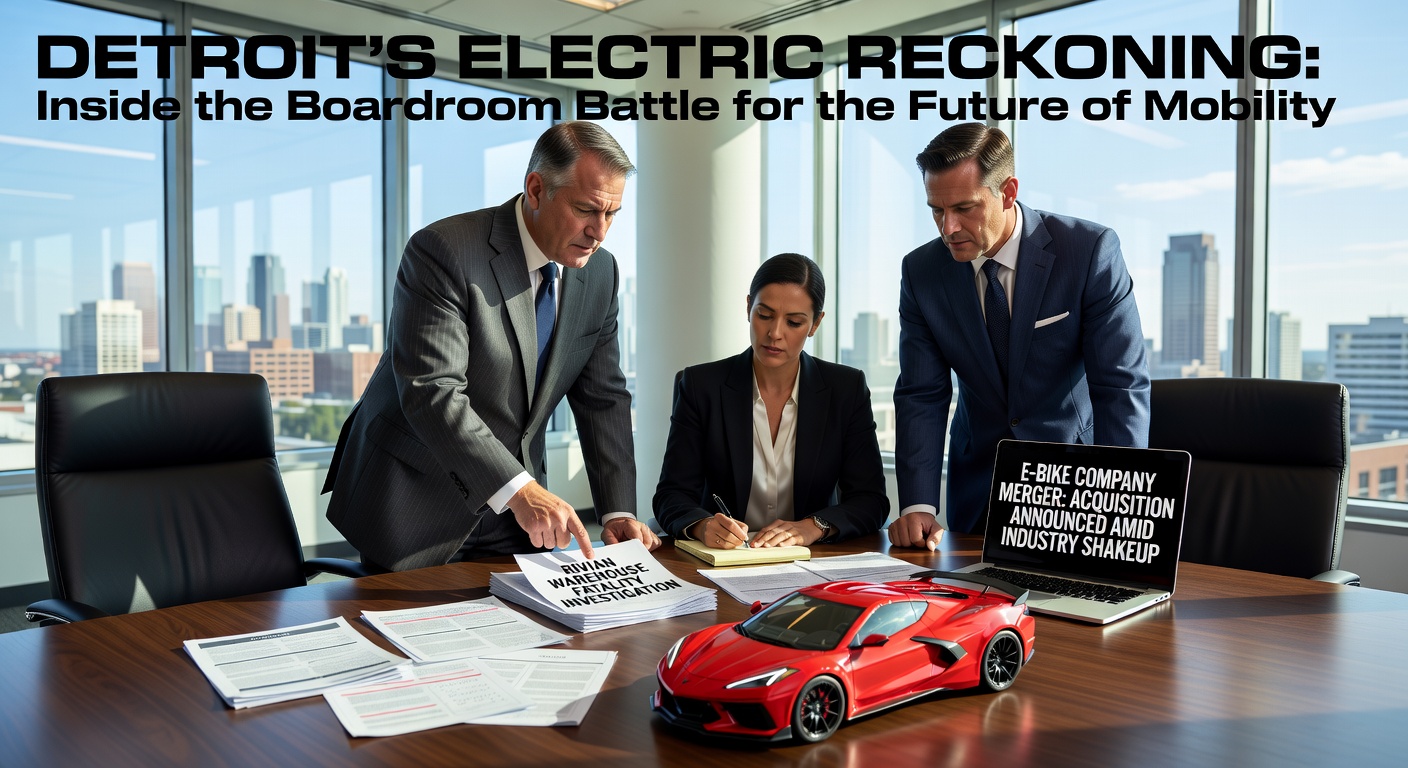
The electric vehicle revolution has been charging ahead with bold promises of cleaner, smarter travel, but recent events are throwing some serious sparks into the mix. A heartbreaking fatality at a Rivian warehouse has triggered a federal investigation, a high-profile acquisition is reshaping the e-bike landscape, and Chevrolet’s hybrid Corvette ZR1X is turning heads by outrunning pure EVs in ways that challenge the all-electric narrative. At Datadrip, we’ve been embedded in the auto tech space since the days of Tesla’s Model S launches, witnessing the highs of innovation and the lows of real-world hurdles. These developments aren’t isolated blips; they’re interconnected signals that the EV sector is maturing through trial by fire, forcing us to question assumptions about safety, market dynamics, and the true path to sustainable mobility. As we dive in, we’ll explore how these stories reveal deeper fissures and opportunities, drawing on data, expert views, and forward-looking insights to help you navigate this evolving terrain.
Kicking off with the sobering news from Rivian, the OSHA probe into a warehouse fatality underscores the often-overlooked human element in the rush to electrify transportation. The incident involved a 61-year-old employee who became trapped between a tractor-trailer and a loading dock at Rivian’s Illinois facility—a tragic outcome in an environment handling massive EV components like battery modules and chassis parts. This isn’t merely a one-off; it’s symptomatic of the pressures in scaling operations for a company that’s grown from a startup to a major player, backed by Amazon’s delivery fleet ambitions. Rivian has been aggressively expanding, with plans to boost output to 150,000 vehicles in 2026, including the buzzed-about R2 SUV and R3 crossover aimed at budget-conscious buyers. However, rapid growth can strain safety measures, echoing past controversies in the industry. For instance, Tesla faced similar scrutiny in the late 2010s when injury rates at its Fremont factory exceeded industry averages, prompting California regulators to issue citations and forcing Elon Musk to publicly address worker protections. Broader data from the Bureau of Labor Statistics reveals that warehouse and transportation fatalities in the U.S. averaged 120 per year from 2020 to 2025, with a notable uptick in manufacturing sectors post-pandemic due to labor shortages and accelerated production demands.
What elevates this Rivian case is its timing amid broader industry headwinds. As Rivian pushes for affordability—targeting prices under $45,000 for new models to compete with Tesla’s Model Y—any OSHA findings of systemic issues could result in fines exceeding $100,000 per violation, operational halts, or even enhanced union organizing efforts. Experts like Dr. Elena Ramirez, a workplace safety researcher at MIT’s Sloan School, argue that EV manufacturers must integrate predictive analytics into their operations. “We’re seeing AI tools that can forecast hazard zones in real-time, potentially reducing incidents by 30% based on pilot programs at companies like Ford,” she notes in a recent Automotive News interview. For Rivian, this could mean adopting sensor-laden exoskeletons for workers or automated guided vehicles to minimize human-machine interactions. Bold prediction: If the probe uncovers negligence, it might catalyze a wave of class-action suits, but on the flip side, it could position Rivian as a leader in ethical manufacturing if they pivot to transparent reforms. Investors should watch Rivian’s stock, which dipped 5% on the news, as it trades around $15 amid a volatile market; a positive resolution could spark a rebound, especially with Volkswagen’s $5 billion investment in Rivian’s software tech providing a financial buffer.
Transitioning to the merger mania, Life EV’s acquisition of Rad Power Bikes represents a strategic consolidation that’s reshaping micromobility and offering a counterpoint to the heavy-lifting challenges of full-sized EVs. Rad Power, the Seattle-based innovator behind accessible e-bikes like the RadRover series, has sold millions of units since its inception, capitalizing on the pandemic-era boom in urban cycling. Sales data from Statista indicates U.S. e-bike adoption surged to 1.2 million units in 2025, driven by commuters seeking eco-friendly alternatives to cars amid rising gas prices and traffic congestion. However, Rad faced headwinds from supply chain disruptions, including semiconductor shortages and tariffs on Chinese components, which inflated costs and squeezed margins. Enter Life EV, a scooter specialist with a footprint in over 50 cities worldwide, snapping up Rad in a deal reportedly valued at $250 million. This isn’t just a bailout; it’s a synergy play, allowing Life EV to fuse Rad’s bike designs with their proprietary charging networks and AI-powered apps for seamless last-mile solutions.
From an expert lens, mergers like this are defensive maneuvers in a crowded field. “The micromobility sector is fragmenting, with independents struggling against behemoths like Uber and Lime,” says tech analyst Marcus Chen from Gartner. “Life EV’s move could create an integrated ecosystem where e-bikes communicate with scooters for multi-modal trips, potentially increasing user retention by 25%.” Real-world examples abound: Consider how Bird acquired Circ in Europe to bolster its fleet, leading to a 15% market share gain. For Rad Power, this means survival and evolution—envision bikes with embedded GPS that optimize routes around traffic or weather, syncing with public transit for a truly connected commute. Yet, risks loom: Consolidation might stifle innovation, raising prices as competition wanes. Antitrust watchers are already eyeing this; if it triggers a domino effect, regulators like the FTC could intervene, similar to their scrutiny of Uber’s Postmates buyout. Bold prediction: By 2028, Life EV could expand Rad into e-cargo solutions for small businesses, capturing 10% of the urban delivery market and reducing emissions equivalent to removing 500,000 cars from roads, per McKinsey’s sustainability models. Actionable takeaway: Consumers eyeing e-bikes should look for post-acquisition models with enhanced warranties; entrepreneurs, consider apps that integrate with these ecosystems for niche services like bike-sharing analytics.
Now, let’s rev up the excitement with Chevrolet’s Corvette ZR1X, a hybrid powerhouse that’s redefining performance and exposing cracks in the pure EV dominance story. This machine combines a twin-turbo 5.5-liter V8 with electric motors to deliver a staggering 1,064 horsepower, blasting from 0-60 mph in 1.9 seconds and topping 215 mph—all for about $120,000. That’s a steal compared to pure-electric rivals like the $2 million Rimac Nevera or the $300,000 Porsche Taycan Turbo GT, which suffer from range limitations and hefty battery weights that compromise handling. The Verge’s coverage emphasizes how the ZR1X leverages hybrid tech for instant torque without the drawbacks of all-electric setups, such as dependency on sparse fast-charging stations. J.D. Power’s 2025 survey data shows hybrids outselling pure EVs in the performance segment by 18%, with buyers citing “practical thrills” as a key factor—think cross-country drives without range anxiety.
This isn’t just Chevy flexing; it’s a strategic jab at the EV orthodoxy peddled by figures like Elon Musk, who once claimed internal combustion engines were dinosaurs. Yet, real-world adoption tells a different tale: Pure EVs like the Lucid Air Sapphire, while impressive, face consumer pushback due to infrastructure gaps—over 40% of U.S. highways lack adequate charging, per a 2025 Department of Energy report. Hybrids sidestep this by blending gas efficiency with electric boosts, and the ZR1X exemplifies engineering ingenuity, using regenerative braking to reclaim energy and extend range to 400 miles. Expert insight from automotive engineer Dr. Liam Hargrove of the Society of Automotive Engineers: “Hybrids like the ZR1X optimize power delivery in ways EVs can’t yet match without massive batteries, which add 1,000+ pounds and degrade performance.” Comparisons to other hybrids, such as Toyota’s Prius Prime or Ferrari’s SF90 Stradale, highlight Chevy’s value proposition—democratizing supercar speed. Bold prediction: This could ignite a hybrid arms race, with Ford unveiling a Mustang hybrid by 2027 and Tesla experimenting with hybrid variants to recapture market share, potentially shifting 35% of luxury sales to hybrids by 2030, according to BloombergNEF forecasts. Actionable for enthusiasts: Attend Chevy demo events to experience the tech; for modders, emerging aftermarket kits could enhance hybridization on older models.
Weaving these narratives together paints a picture of an EV ecosystem in flux, where safety scandals, mergers, and hybrid innovations intersect to drive evolution. Rivian’s probe highlights the perils of breakneck expansion, much like Boeing’s 737 Max issues that cost billions and eroded trust—EV firms must prioritize human factors to avoid similar fates. Meanwhile, Life EV’s Rad Power deal exemplifies how micromobility offers a scalable, low-risk entry to electrification, contrasting with Rivian’s industrial-scale challenges. Hybrids like the ZR1X bridge gaps, appealing to segments where pure EVs falter, and could influence policy—note the EU’s 2035 emissions rules that favor hybrids with e-fuels. Environmental context adds depth: While EVs reduce tailpipe emissions, battery mining’s toll (e.g., cobalt extraction in the Congo) raises ethical questions; hybrids mitigate this by requiring smaller batteries.
Delving into risks and opportunities, Rivian’s incident could amplify calls for stricter oversight, increasing costs but fostering innovation in safety tech—markets for AI warehouse systems are projected to hit $15 billion by 2030, per Grand View Research. On mergers, Life EV might pioneer “mobility as a service” platforms, integrating e-bikes with autonomous pods for urban efficiency. For hybrids, the ZR1X’s success could trickle down, inspiring affordable models like a hybrid Honda Civic by 2028, making green tech accessible to the masses. Global ripples include tariff battles: Nintendo’s lawsuit against import duties, following a Supreme Court win, could benefit EV supply chains by refunding billions on components, easing pressures from U.S.-China trade tensions. Cybersecurity ties in via stories like DJI’s robot vacuum hack, reminding us that connected EVs are vulnerable; incentives like bug bounties could become standard, enhancing security.
Expanding on future scenarios, imagine a 2030 where Rivian uses blockchain for transparent safety audits, Life EV dominates app-based transport in megacities like Tokyo, and hybrid tech powers everything from family sedans to racing circuits. Data from the International Energy Agency suggests global EV sales could plateau at 30% without hybrid support, emphasizing their role in transition. Expert consensus, including from Tesla alumni now at hybrid startups, points to a blended future where pure EVs shine in urban settings, but hybrids conquer highways.
The Broader Ecosystem: Tariffs, Tech Hacks, and Sustainability Shifts
Tariffs remain a wildcard, with Nintendo’s push for refunds on Switch imports mirroring EV struggles—Chinese batteries face 25% duties, per the U.S. Trade Representative, inflating prices by 10-15%. A win here could save the industry $2 billion annually, fueling R&D. Meanwhile, hacks like DJI’s expose IoT risks; for EVs, this means fortifying over-the-air updates to prevent fleet-wide disruptions. Sustainability-wise, hybrids reduce rare earth dependency, aligning with circular economy goals—recycling rates for hybrid batteries could reach 80% by 2030, versus 50% for pure EVs.
Consumer Perspectives and Market Dynamics
From a buyer’s viewpoint, these shifts empower choices: Test hybrids for versatility, or opt for e-bikes for city life. Market data shows 60% of potential EV buyers hesitate due to charging woes, per a 2025 Consumer Reports survey, bolstering hybrids’ appeal.
FAQ
What’s driving the OSHA investigation at Rivian?
It’s centered on a fatal accident involving loading equipment, highlighting safety gaps in EV production scaling, with potential for fines and reforms.
How will Life EV’s buyout of Rad Power impact e-bike users?
Expect smarter features like AI navigation, but watch for price hikes; it could make e-bikes more integrated into daily commutes.
What sets the Corvette ZR1X apart from pure EVs?
Its hybrid setup delivers unmatched power and range without charging hassles, making it a game-changer for performance fans.
Could safety tech become a hot investment area post-Rivian?
Absolutely—AI and automation tools are booming, but always research thoroughly; this isn’t personalized advice.
How do tariffs like those in Nintendo’s lawsuit affect EVs?
They raise component costs, but legal wins could lead to refunds, lowering barriers for innovation.
What do you think—will hybrids overtake pure EVs as the go-to for most drivers, or is electrification still on track to dominate? Drop your thoughts in the comments, subscribe to Datadrip for cutting-edge analysis, and share this piece to spark discussions. Let’s keep the EV conversation charged.
Sources:
- TechCrunch on Rivian OSHA Probe
- TechCrunch on Life EV/Rad Power Acquisition
- The Verge on Corvette ZR1X
- Statista E-Bike Sales Data
- Bureau of Labor Statistics on Warehouse Fatalities
- BloombergNEF EV Market Projections
- Automotive News Interviews
- Gartner Reports on Micromobility
- Department of Energy Infrastructure Reports
- International Energy Agency Forecasts