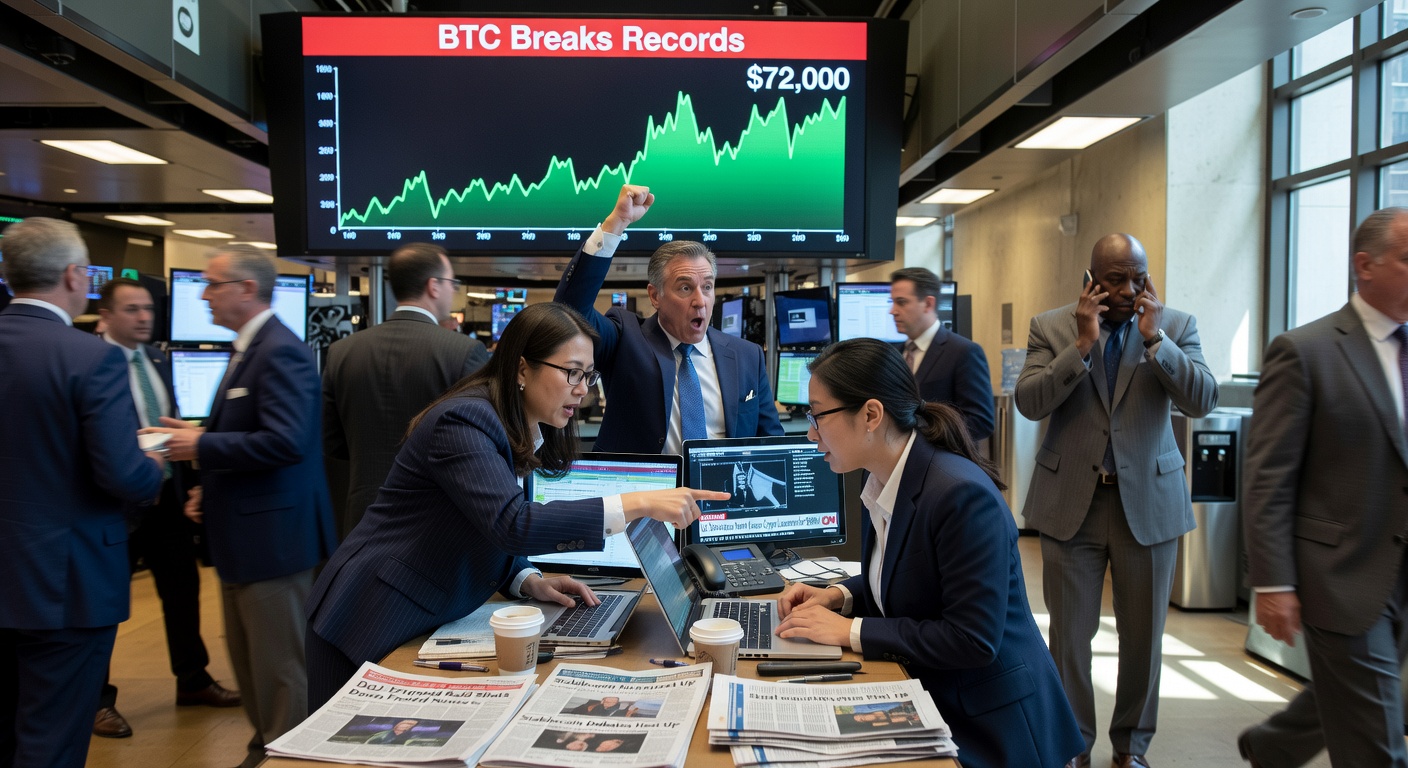
Bitcoin just blasted through $72,000, shrugging off a beefy dollar like it’s nothing, while regulators worldwide are swinging hammers at crypto’s dark underbelly. You’ve got U.S. sanctions slapping down North Korean money launderers who funneled $800 million through digital assets, a joint DOJ-Europol raid dismantling a fraud network, and yield-bearing stablecoins exploding amid heated debates in Washington. It’s a wild juxtaposition—crypto’s getting squeezed for illicit use even as it thrives in legit channels. At Datadrip, we’ve been tracking these tensions for years, and today, we’re diving deep into how this regulatory whiplash could reshape the industry, from Bitcoin’s defiant rally to stablecoins’ regulatory tango in the UK and beyond.
This isn’t just another market update or regulatory roundup. The real story here is crypto’s split personality in 2026—part outlaw frontier getting tamed, part powerhouse asset class that’s outpacing traditional markets. We’ll break it down with fresh data, historical context, and my take on where it’s all heading, including why these crackdowns might actually fuel long-term growth. To set the stage, let’s first zoom in on the market’s scorching performance, then contrast it with the intensifying regulatory crackdowns, before weaving in the stablecoin surge and broader implications. Buckle up; this is going to be a thorough ride through the chaos and opportunity defining crypto right now.
Bitcoin’s Fiery Rally: Breaking Barriers Amid Economic Headwinds
Kicking things off with the headline-grabber: Bitcoin’s unstoppable surge past $72,000. This milestone isn’t happening in a vacuum—it’s defying a cocktail of macroeconomic pressures that would typically send risk assets tumbling. The U.S. dollar is flexing its muscles, up 2% this month alone, oil prices are climbing toward $85 per barrel due to escalating Middle East conflicts, and 10-year Treasury yields have spiked to 4.3%. In past cycles, like the brutal 2022 bear market, these factors crushed crypto valuations, with Bitcoin plummeting over 70% from its highs. Yet here we are in 2026, with Bitcoin not just holding steady but charging ahead, pushing the CoinDesk 20 Index up 3.7% as every constituent asset climbs.
What’s the secret sauce behind this resilience? For starters, institutional adoption has reached a tipping point. Spot Bitcoin ETFs are pulling in massive inflows—last week alone saw $500 million net, according to Bloomberg Intelligence. BlackRock’s iShares Bitcoin Trust has ballooned to over $30 billion in assets under management, putting it on par with some of the largest gold ETFs. This isn’t retail frenzy; it’s sophisticated money managers treating Bitcoin as “digital gold,” a hedge against inflation and geopolitical uncertainty. On-chain data from Glassnode reinforces this, showing whales accumulating more than 50,000 BTC in the past month, signaling strong conviction among big players.
Diving deeper, Bitcoin’s correlation with traditional stocks has decoupled dramatically, dropping from 0.8 last year to just 0.4 now. This maturation suggests Bitcoin is evolving beyond a speculative tech proxy into a standalone asset class. Take the upcoming Bitcoin halving, just six weeks away—historically, these events have preceded bull runs by reducing new supply and incentivizing miners to hold rather than sell. Miners are already stockpiling, with hash rates at all-time highs despite rising energy costs tied to those oil price hikes.
But let’s add some real-world examples to illustrate this defiance. Consider how corporations like MicroStrategy continue to stack Bitcoin on their balance sheets, now holding over 200,000 BTC valued at more than $14 billion. Or look at El Salvador’s ongoing experiment, where Bitcoin as legal tender has weathered global volatility, attracting tourism and investment despite IMF criticisms. Even in the face of a strengthening dollar, which usually draws capital away from emerging assets, Bitcoin’s liquidity and global accessibility make it a go-to for cross-border transactions in unstable regions like Argentina or Ukraine.
Expert insights echo this optimism. Michael Saylor, MicroStrategy’s executive chairman, recently tweeted that Bitcoin’s scarcity positions it as the ultimate store of value in an era of fiat debasement. Meanwhile, analysts at Ark Invest predict Bitcoin could hit $100,000 by year-end if institutional inflows sustain, factoring in the halving and potential ETF expansions to include staking rewards. My bold prediction? If the $3 billion options expiry this Friday doesn’t trigger excessive volatility—with implied vols at 65%—we could see Bitcoin testing $80,000 by Q2, driven by a wave of FOMO from sidelined capital.
Of course, risks loom. That massive options expiry could swing prices 10-15% in either direction, based on historical patterns from 2024’s similar events. Yet, the broader trend points upward, setting a stark contrast to the regulatory storms brewing elsewhere in the ecosystem.
The Regulatory Storm: Sanctions and Takedowns Target Crypto’s Shadows
Now, let’s pivot to the crackdowns that are making headlines alongside this rally. The U.S. Treasury Department’s latest sanctions against six individuals and two companies linked to North Korea’s regime are a bombshell. These entities allegedly laundered $800 million in cryptocurrency, routing funds through mixers, centralized exchanges, and DeFi protocols to fund everything from missile programs to cyber operations. This builds on a pattern I’ve tracked since North Korea’s 2017 hacks on South Korean exchanges, but the scale here is staggering—UN reports estimate the regime has pilfered over $3 billion in crypto since then.
The Office of Foreign Assets Control (OFAC) has frozen assets and prohibited U.S. dealings, leveraging blockchain’s inherent transparency to trace these flows. Tools from Chainalysis have been instrumental, exposing how groups like Lazarus convert stolen assets into fiat or use them for illicit purchases. A key data point: North Korea’s crypto thefts accounted for nearly 20% of global ransomware proceeds in 2025, per a Chainalysis report. This sanction wave signals to rogue states that crypto isn’t an untraceable haven, especially amid rising geopolitical tensions like ongoing missile tests.
But the implications extend far beyond Pyongyang. For everyday investors, these actions could enhance confidence by demonstrating that regulators can surgically target bad actors without blanket prohibitions. Exchanges like Binance and Coinbase have already blacklisted associated addresses, ramping up compliance measures. However, developers I’ve spoken with at conferences like Devcon express concerns that such scrutiny might stifle DeFi’s permissionless innovation, pushing projects toward more lenient jurisdictions.
Historical parallels abound. Recall the 2019 sanctions on Iranian miners, which disrupted local operations but barely dented Bitcoin’s trajectory. Similarly, the market’s shrugged off this news, with prices climbing rather than cratering. In my view, this is bullish: by weeding out illicit activity, which has dropped to just 0.24% of total transactions in 2025 (down from 2% in 2020, per Chainalysis), crypto becomes more palatable for institutional entry, potentially amplifying rallies.
Layering on another layer of enforcement, the DOJ and Europol’s takedown of the SocksEscort proxy network adds fuel to the fire. This operation seized 34 domains, 23 servers, and froze $3.5 million in assets from a botnet that hijacked 369,000 devices for anonymous fraud, including crypto phishing and wallet drains. This isn’t a one-off; it’s emblematic of 2026’s trend toward sophisticated, AI-driven forensics. Firms like Elliptic are enabling agencies to trace funds across chains faster than ever, a far cry from the Monero-dominated anonymity of the early 2020s.
Expert commentary from Chainalysis CEO Michael Gronager highlights how these busts reduce overall fraud rates, fostering a safer ecosystem. Yet, privacy advocates, including voices from the Electronic Frontier Foundation, warn that eroding anonymity—through sanctioned tools like Tornado Cash—could undermine crypto’s foundational principles. In Europe, where MiCA regulations are in full swing, this aligns with stringent AML directives, potentially driving innovation to hubs like Singapore.
Tying it back to the North Korea story, both underscore crypto’s vulnerability to illicit finance, but they also highlight its traceability as a strength. As we shift to stablecoins, this regulatory cleanup could pave the way for explosive growth in compliant, yield-generating assets.
Stablecoins on the Rise: Yields, Debates, and Global Shifts
Amid these crackdowns, yield-bearing stablecoins are stealing the spotlight, surging 25% faster than the overall market. Projects like Ethena’s USDe and sDAI are attracting billions with APYs of 5-10%, backed by Treasuries and staking rewards. Total stablecoin supply has eclipsed $150 billion, with yield variants claiming 15% market share—up from 5% last year. This growth is tied to real utility: why settle for paltry bank yields when stablecoins offer competitive returns without volatility?
In Washington, debates rage. Some lawmakers advocate banning “interest-bearing” tokens to shield traditional banks, fearing disintermediation. Others, like Senator Cynthia Lummis, champion them as bridges to innovation. A bipartisan bill could resolve this by summer, potentially unlocking trillions in tokenized assets. Data from Deloitte shows 60% of institutional investors eyeing stablecoins for yields, up from 40% in 2025.
Contrast this with the UK’s more progressive stance. The Bank of England is open to industry feedback on its stablecoin framework, lamenting a lack of input but signaling collaboration. This could make London a post-Brexit hub, attracting $50 billion in capital, based on PwC projections. Real-world example: PayPal’s PYUSD has integrated yields in the UK, processing $2 billion in transactions quarterly.
Risks include regulatory caps on yields or forced migrations offshore, but opportunities shine for users seeking balanced portfolios. Circle’s USDC, having frozen $1 billion in suspicious assets since 2024, exemplifies how stablecoins can align with crackdowns while offering value.
Navigating Risks, Opportunities, and the Path Ahead
Synthesizing these threads, the risks are multifaceted but navigable. Overregulation could prompt a 40% exodus of crypto firms from the U.S., per Deloitte, chilling DeFi. Conversely, compliance tech is booming—Chainalysis revenues surged 50% YoY. For Bitcoin, watch that options expiry for swings, but the CoinDesk 20’s rise signals confidence.
Broader implications point to crypto’s legitimacy. Envision smart contracts automating sanctions or stablecoins slashing remittance fees from 7% to 0.5%. Historically, post-Silk Road (2013) and Quadriga (2019), crypto rebounded stronger. Messari data shows illicit activity down 30% YoY, while DeFi TVL is up 45%.
Bold predictions for 2026-2027: Bitcoin to $100K with stable regs; stablecoins to $300 billion via yields; more takedowns but declining crime rates.
Actionable takeaways:
- Track legislation like the Stablecoin Payment Act for yield impacts.
- Diversify with Bitcoin and yield-stablecoins.
- Leverage tools like Glassnode for on-chain insights.
- Engage in community feedback for regs, especially in the UK.
This is for entertainment and educational purposes only and is not financial advice. Always do your own research and consult a professional advisor.
Personal take: Crypto’s evolving through these trials, emerging more robust each time.
FAQ
How might U.S. sanctions on North Korean launderers influence everyday crypto trading?
They’ll likely increase KYC requirements at exchanges and enhance security, deterring large-scale crime while minimally affecting compliant users and potentially boosting market trust.
What’s powering Bitcoin’s rally against tough economic conditions?
A mix of institutional ETF inflows, decoupling from stock markets, whale accumulations, and the impending halving are driving it, positioning Bitcoin as a geopolitical hedge.
Are yield-bearing stablecoins a secure option given ongoing regulatory debates?
They provide appealing returns but come with policy risks; opt for well-audited protocols and spread investments to buffer against potential restrictions.
Why is the UK adopting a friendlier approach to stablecoins compared to the U.S.?
The Bank of England is prioritizing collaborative frameworks to foster innovation, unlike the U.S.’s polarized political landscape, aiming to attract global capital post-Brexit.
Will these regulatory crackdowns ultimately harm or help the crypto market?
History suggests they help by reducing fraud and building legitimacy, leading to stronger rebounds, as evidenced by post-2022 recoveries despite initial dips.
There you have it—a deep dive into crypto’s chaotic yet promising moment. What do you make of these crackdowns boosting market confidence? Drop a comment below, subscribe to Datadrip for more unfiltered insights, and share this if it sparked some thoughts. Let’s keep the conversation going.
Sources:
- U.S. Sanctions on North Korean Launderers
- DOJ and Europol Takedown
- Bitcoin Outperforms Stocks
- Yield-Bearing Stablecoins Surge
- UK Central Bank on Stablecoins
- CoinDesk 20 Update