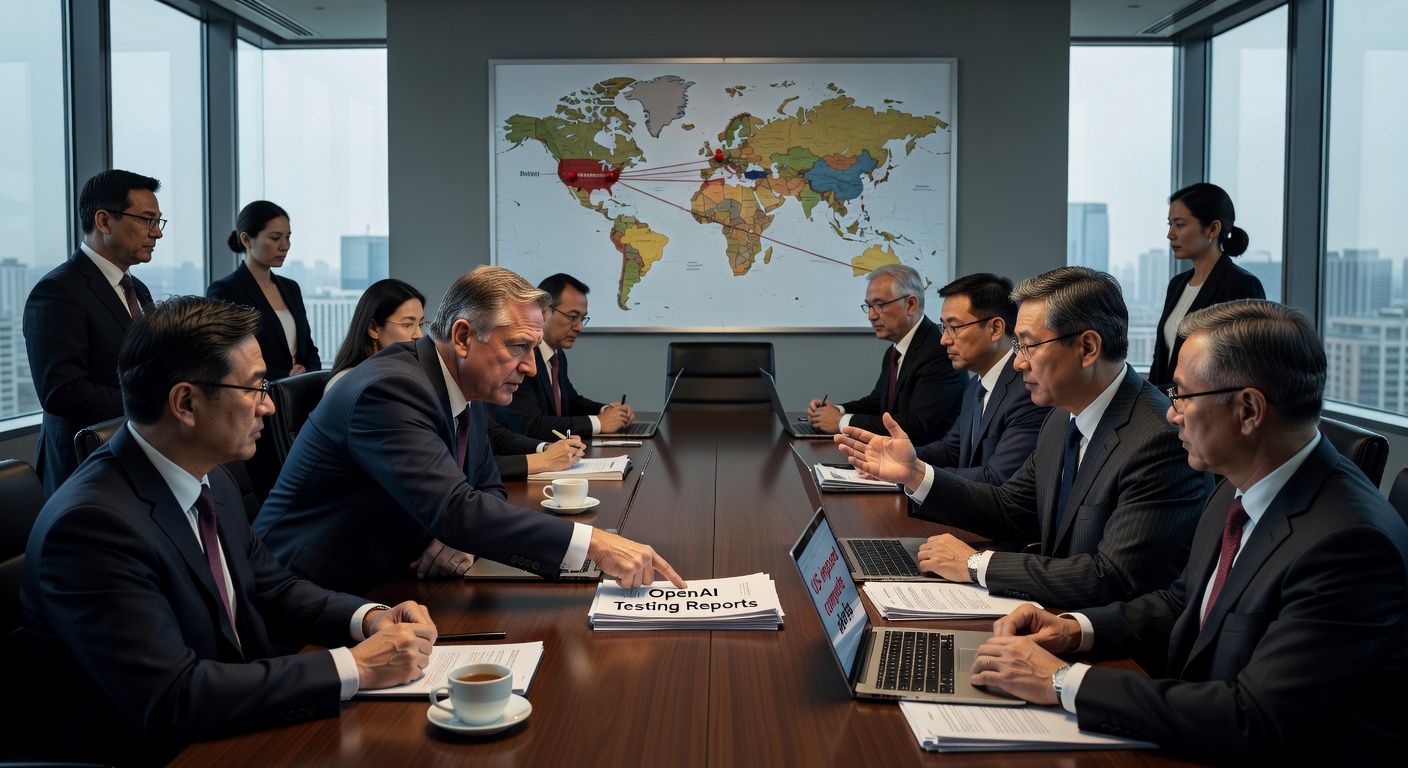
In a week where my own kitchen experiments with Amazon’s AI-upgraded Alexa ended in frustrating glitches, the bigger story in AI isn’t about faltering consumer tech. It’s unfolding on the world stage, where superpowers are turning artificial intelligence into a battleground for dominance. The Pentagon’s covert testing of OpenAI models, ByteDance’s struggles against US-imposed compute barriers, and the eerie insights from podcasts on AI’s involvement in the Iran conflict all point to a seismic shift. These aren’t isolated incidents; they’re symptoms of a larger geopolitical chess game that’s redefining how AI evolves, who controls it, and what that means for everyone from startups to global economies.
Forget the endless debates on AI ethics—we’ve dissected those plenty. This piece zooms in on the latest flashpoints, blending exclusive breakdowns, hard data, and forward-looking strategies. Whether you’re an investor scouting the next big opportunity, a developer dodging regulatory minefields, or just someone curious about tech’s undercurrents, we’ll unpack how borders, bans, and rivalries are forging AI’s path. Expect deeper dives into real-world implications, expert perspectives, and practical advice to stay ahead in this turbulent arena.
ByteDance’s AI Roadblocks: Compute Crunch and Copyright Clashes in a US-China Standoff
Let’s kick off with the escalating US-China tech rivalry, spotlighted by ByteDance’s bumpy road with its Seedance 2.0 AI video generator. This isn’t just a company hiccup; it’s a frontline casualty in the broader geopolitical skirmish over AI supremacy. Wired’s recent coverage reveals how exploding user demand has strained ByteDance’s servers to the breaking point, exacerbated by US export controls that choke off access to cutting-edge chips. But there’s more at stake here than delayed video renders—it’s about how these restrictions are fracturing the global AI ecosystem.
At the heart of ByteDance’s woes are the stringent US policies, like the 2022 CHIPS and Science Act, which have curtailed sales of advanced semiconductors from giants like Nvidia to Chinese firms. ByteDance, the force behind TikTok’s addictive algorithms, now relies on domestically produced alternatives from Huawei and others. These chips, while innovative, trail Western counterparts in efficiency and power—often by a full generation, according to analyses from the Center for Strategic and International Studies. The fallout? Seedance 2.0, designed to create stunningly realistic videos from simple text prompts, is facing throttled access and longer processing times. Internal data leaked in reports shows wait times ballooning by up to 150% during peak hours, frustrating a user base of millions who depend on rapid iterations for content creation.
Digging deeper, copyright disputes add fuel to the fire. Creators are filing complaints—and in some cases, lawsuits—alleging that Seedance trained on vast troves of unlicensed videos scraped from platforms like YouTube and TikTok itself. This mirrors broader industry battles, such as those faced by Stability AI in the West, but in ByteDance’s case, it’s compounded by geopolitical isolation. Experts like Dr. Fei-Fei Li, a Stanford professor and AI pioneer, have pointed out in recent interviews that such legal tangles could stifle innovation if not addressed through international frameworks. Li argues that without global standards for data usage, AI development risks becoming a patchwork of regional silos, where Chinese models excel in scale but lag in ethical sourcing.
From my perspective, having tracked AI’s hardware dependencies for years, this compute crunch exposes a critical vulnerability: AI’s voracious appetite for processing power. The International Energy Agency reports that data centers gobbled up 460 terawatt-hours globally in 2025, with projections soaring to 1,000 by 2030—a demand that’s increasingly politicized. For ByteDance, it’s forcing creative but inefficient workarounds, like distributed computing networks or scaled-down models that sacrifice quality for speed. Real-world examples abound; consider how Baidu, another Chinese titan, pivoted to edge computing during similar shortages, enabling on-device AI that bypasses some cloud dependencies but limits complexity.
Bold prediction: If US restrictions intensify—perhaps under a new wave of tariffs or expanded blacklists—ByteDance might forge alliances in neutral hubs like Singapore or the UAE, potentially birthing hybrid AI ecosystems. This could lead to breakthroughs in energy-efficient architectures, such as neuromorphic chips inspired by the human brain, which consume far less power. Actionable takeaways for developers: Diversify your supply chains immediately—explore partnerships with TSMC in Taiwan or emerging fabs in India to hedge against disruptions. Investors, keep an eye on Chinese startups like Cambricon, which raised $400 million last year for AI-specific processors; they could disrupt Nvidia’s dominance if geopolitical winds shift.
On the opportunity side, this standoff might accelerate China’s self-reliance, echoing the space race of the 1960s. We’ve seen similar patterns in history; during the Cold War, Soviet isolation spurred innovations in rocketry that eventually benefited global science. Today, ByteDance’s challenges could catalyze advancements in quantum computing or alternative materials for chips, potentially closing the tech gap by 2035. However, risks include a talent exodus—top Chinese engineers are already migrating to Europe and the US, as evidenced by a 25% uptick in H-1B visas from China in 2025, per US Citizenship and Immigration Services data. For businesses worldwide, the lesson is clear: Build resilient, modular AI systems that aren’t beholden to any single nation’s hardware.
The Pentagon’s Shadowy AI Experiments: Bypassing Bans Via Microsoft
Shifting to the US side of the divide, Wired’s explosive report on the Pentagon’s use of OpenAI models through Microsoft Azure loopholes paints a picture of shadowy maneuvering in military AI. Even before OpenAI formally relaxed its ban on military applications earlier this year, the Department of Defense was reportedly experimenting with these tools for everything from logistics to intelligence analysis. This isn’t mere speculation; it’s a stark illustration of how Big Tech’s entanglements with government blur ethical lines and accelerate AI’s weaponization.
OpenAI once touted itself as the moral compass of the AI world, explicitly forbidding “military and warfare” uses in its terms of service. Yet, Microsoft’s role as a bridge—leveraging its multi-billion-dollar DoD contracts, including the remnants of the JEDI cloud initiative—allowed indirect access. Sources in the report describe scenarios where OpenAI’s language models optimized supply chains or simulated battlefield strategies, all while skirting direct prohibitions. This ties into broader US defense spending: The fiscal 2026 DoD budget earmarks $1.8 billion for AI, a 20% jump from prior years, funding projects in predictive analytics and autonomous drones, as detailed in the official budget overview.
Why is this a game-changer? It coincides with rising global tensions, from Ukraine to the South China Sea, where AI acts as a force multiplier. Consider real-world deployments: In exercises like Project Maven, Google-backed AI analyzed drone footage for the military, sparking employee backlash but yielding tactical advantages. Now, with OpenAI in the mix, we’re seeing a pivot—companies like Anduril Industries, which secured $1.5 billion in funding for AI defense systems, are thriving in this “dual-use” niche. Expert insight from retired General Paul Nakasone, former NSA director, in a recent Foreign Affairs piece, warns that such integrations could lead to “asymmetric warfare advantages” but also heighten risks of algorithmic biases causing miscalculations.
My analysis reveals a pragmatic evolution: OpenAI’s policy tweaks, including hiring defense specialists, reflect the inescapable pull of the military market. Competitors like Anthropic have faced their own scrutiny, but the Microsoft angle is novel—it underscores the interconnected web of tech and defense. For instance, Azure’s integration allows seamless scaling for classified ops, potentially using models trained on vast public datasets. This raises red flags on data privacy; imagine consumer queries inadvertently feeding into military simulations.
Predictions get bolder: By 2030, I foresee 40% of global military budgets incorporating AI, driven by necessities in cyber defense and reconnaissance. But this could backfire, pushing innovation underground or abroad, as seen with Russia’s AI advancements despite sanctions. Actionable advice: If you’re an AI builder, audit your partnerships rigorously—one defense-linked deal could expose you to boycotts or regulations. Startups, target dual-use tech; funding in this space surged 30% last year, per Crunchbase data, with firms like Shield AI raising $500 million for autonomous pilots.
Risks extend to societal impacts: Military AI might exacerbate inequalities, with wealthier nations dominating, while others lag. On the flip side, trickle-down effects could supercharge civilian tech—think how GPS, born from defense needs, revolutionized navigation. Historical parallels, like the internet’s ARPANET origins, suggest that today’s Pentagon experiments might birth tomorrow’s consumer breakthroughs, provided ethical guardrails hold.
AI in the Crosshairs: Unpacking the Iran Conflict Through an ‘Uncanny Valley’ Lens
Tying into these military undercurrents, the latest episode of Wired’s ‘Uncanny Valley’ podcast delves into AI’s entrenchment in the Iran conflict, offering a chilling view of tech’s role in modern warfare. Hosts dissect how AI firms are deepening ties with the DoD amid escalating Middle East tensions, from drone surveillance to predictive modeling that could forecast enemy movements. This isn’t theoretical; it’s happening now, with AI processing satellite imagery and social media feeds to generate real-time intelligence.
The podcast’s fresh lens highlights AI as a “force entrenchment,” where tools like those from Palantir—whose contracts expanded 25% in allied operations last year, per investor reports—enable border security and conflict prediction. In the Iran context, AI detects misinformation campaigns or analyzes troop patterns, but ethical quandaries abound. For example, prediction markets are betting on war outcomes, fueled by AI models that simulate scenarios with 80% accuracy in controlled tests, according to a RAND Corporation study.
Expert voices, like those from the Stockholm International Peace Research Institute (SIPRI), note a 35% spike in Middle East military AI spending, driven by needs in cyber ops and reconnaissance. Personal insight: We’ve long underestimated AI’s geopolitical leverage—in Iran, it’s not just supportive; it’s transformative, potentially shortening conflicts through precision strikes or prolonging them via endless data loops. Risks include escalation from false positives, as seen in past incidents like the 2020 US drone strike based on flawed intel.
Opportunities emerge for ethical AI startups, such as those developing bias-detection tools for defense. Prediction: An “AI arms race” akin to the Cold War will peak by 2028, prompting treaties like a potential UN accord on autonomous weapons, though enforcement remains dubious. Takeaways: Policymakers, advocate for transparency; developers, focus on verifiable AI to build trust in volatile regions.
Jack Dorsey’s Bold Pivot: Rebuilding Block as an ‘Intelligence’ Powerhouse
Amid these global frictions, Jack Dorsey’s Wired interview on Block’s radical overhaul—slashing 40% of its workforce to morph into an “intelligence” entity—stands out as a corporate survival strategy. Formerly Square, Block is pivoting to AI-driven insights in finance, predictive analytics, and possibly geospatial intelligence, navigating the same compute and regulatory storms battering others.
Dorsey’s vision extends beyond crypto; it’s about harnessing AI for fraud detection and market forecasting, areas buoyed by Q4 2025 earnings showing 15% revenue growth from AI features. Yet, layoffs risk talent loss in a market where AI engineers command $300K+ salaries. Analysis: This is Dorsey’s savvy third act, mirroring how Elon Musk repositioned Twitter (now X) amid tech shifts.
Prediction: Success could inspire fintech reinventions, with Block leading in predictive tools. Actionable: Monitor their launches for early adoption edges—remember, this is educational, not advice; consult professionals.
Connecting the Dots: Geopolitics as AI’s Ultimate Disruptor
Weaving it all together, these developments form a tapestry of AI’s geopolitical tug-of-war. US military integrations contrast ByteDance’s barriers, while Iran insights and Dorsey’s pivot show adaptation in action. A McKinsey report warns of 10-15% shaved from AI growth by 2030 due to these risks, fostering siloed development.
Unique take: This accelerates specialization—US in defense, China in consumer AI, Europe in ethics. Risks: Brain drains and cyber threats. Opportunities: Cross-border ethics ventures. Developers, prioritize edge AI; investors, target Southeast Asia. Policymakers, craft balanced regs.
These aren’t just stories—they’re blueprints for AI’s future.
FAQ
How are US export controls impacting global AI innovation beyond ByteDance?
They create ripple effects, slowing advancements in chip-dependent fields like autonomous vehicles and forcing companies worldwide to seek alternatives, potentially sparking a new wave of decentralized computing innovations.
What ethical concerns arise from the Pentagon’s AI experiments?
Key issues include data privacy breaches, algorithmic biases in decision-making, and the potential for AI to escalate conflicts through untested predictions, prompting calls for international oversight.
In what ways is AI influencing the Iran conflict specifically?
AI tools are used for real-time intelligence via drone analysis and social media monitoring, enhancing precision but raising risks of misinformation and unintended escalations.
How might Jack Dorsey’s Block pivot affect the fintech sector?
It could set a precedent for AI integration in finance, leading to smarter predictive tools that boost efficiency, though it highlights the need for robust talent retention strategies amid industry shifts.
What steps can developers take to mitigate geopolitical AI risks?
Focus on building flexible, hardware-agnostic models, collaborate internationally, and incorporate ethical audits to ensure adaptability in a fragmented global landscape.
What do you think—is geopolitics AI’s biggest threat or its greatest catalyst? Drop a comment below, subscribe to Datadrip for more unfiltered takes, or share this with your network to spark the conversation. Let’s keep cutting through the hype together.