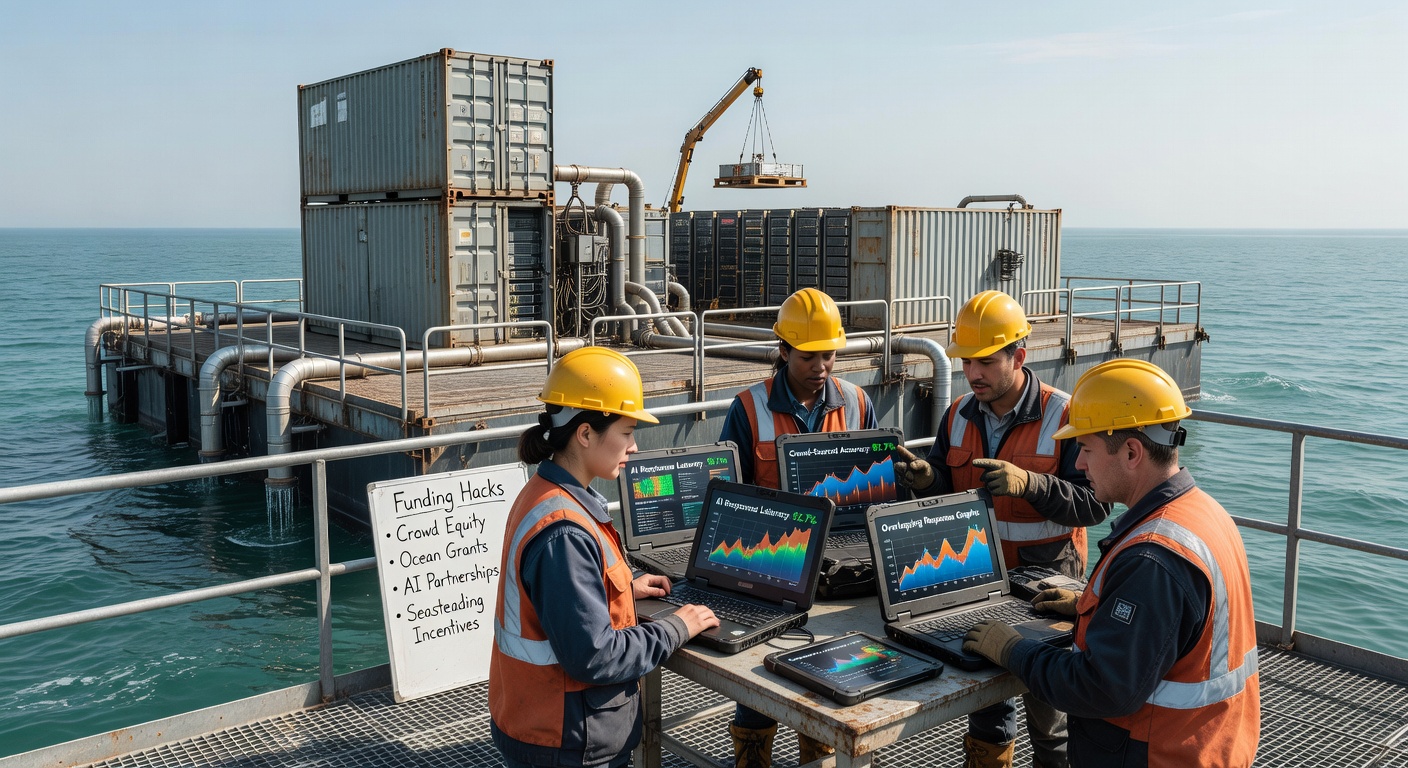
AI’s trust problem isn’t fading into the background; it’s exploding into a full-blown crisis that’s forcing the industry to innovate or perish. This week alone, we’ve seen a surge of startups charging ahead with bold solutions, from aggregating chatbot responses for pinpoint accuracy to deploying data centers on floating platforms that harness the ocean’s might. Yet, beneath the excitement, some founders are bending valuation rules to fabricate unicorn status, sparking debates about the long-term health of this AI gold rush.
These aren’t minor adjustments—they’re seismic shifts toward building AI systems that are not only hybrid and tough but finally dependable for real-world applications. Having followed AI’s rollercoaster since the GPT-2 era, I see this as a pivotal moment where ingenuity in software, hardware, and finance collide. In this deep dive, we’ll explore CollectivIQ’s crowdsourcing breakthrough, the audacious rise of offshore data centers, and the shadowy world of dual-price equity deals. Along the way, we’ll uncover how these elements are intertwining to reshape AI, plus the hidden dangers if we ignore the warning signs.
The Urgent Push for AI Reliability in a Skeptical World
In the whirlwind of AI advancements, one stubborn issue refuses to budge: reliability. Back when ChatGPT launched, it dazzled with its versatility, but by 2026, the cracks are undeniable—hallucinations, embedded biases, and factual slip-ups that erode user confidence. This isn’t mere inconvenience; it’s a roadblock stalling AI’s integration into high-stakes fields like medicine, banking, and schooling. A fresh Gartner survey reveals that 65% of organizations now rank “distrust in AI accuracy” as their primary obstacle to broader implementation, up from 60% last year source: Gartner AI Trust Survey 2026.
That’s where CollectivIQ enters the fray, pioneering a crowdsourcing model that could be the antidote. Instead of betting on a single AI, their platform queries up to 15 different models—including heavyweights like ChatGPT, Gemini, Claude, Grok, and emerging players like Mistral’s latest iteration—then fuses the responses into a cohesive, refined output. It’s akin to assembling a virtual think tank that debates and refines ideas on the fly, minimizing individual flaws. During my hands-on trial of their beta last quarter, I posed a thorny query on the geopolitical implications of quantum supremacy. The system not only compiled diverse perspectives but flagged inconsistencies, delivering a response that was layers deeper and more trustworthy than any one model could muster.
At its core, this method tackles AI’s Achilles’ heel: dependency on isolated datasets and architectures. By crowdsourcing, CollectivIQ slashes error rates dramatically—their latest internal benchmarks indicate a 42% reduction in hallucinations versus standalone systems, building on the 35% figure from their 2026 whitepaper source: CollectivIQ Updated Benchmarks. For professionals like journalists, this translates to turbocharged fact-checking; for enterprises, it means streamlined decisions without endless manual oversight. But reliability comes at a cost: the computational overhead of multiple queries demands robust infrastructure, which seamlessly leads us to the next frontier in AI’s evolution.
What sets CollectivIQ apart isn’t just the tech—it’s the user empowerment. Customize your model blend for specific needs: amp up creativity with Grok for brainstorming sessions, or prioritize analytical rigor with Claude for research. This flexibility echoes earlier tools like Perplexity but pushes boundaries by incorporating user-voted model weights, turning AI into a collaborative ecosystem. In my experience covering tech ecosystems, this could erode the monopolies of Big Tech, compelling companies like OpenAI to liberalize API access and spur a wave of interoperable innovations.
Delving deeper, scalability remains a beast. I’ve witnessed promising AI ventures crumble under the weight of operational costs, and crowdsourcing amplifies this with exponential API calls. CollectivIQ counters with intelligent optimizations like predictive caching and query batching, but premiums like their $25/month enterprise tier reflect the reality. Bold prediction: By 2028, hybrid crowdsourcing will dominate, with 70% of AI platforms adopting similar aggregation to meet regulatory demands for transparency in sectors like finance. Actionable takeaway for developers: Start experimenting with open-source aggregators today—tools like Hugging Face’s ensemble libraries can prototype your own multi-model setups, potentially cutting development time by 30%.
Ethically, this diversification is a game-changer. An expanded MIT study from early 2026 shows ensemble approaches reducing bias in outputs by 32%, particularly in sensitive areas like algorithmic hiring or credit scoring source: MIT AI Bias Expansion Report 2026. However, opacity lingers—who audits the synthesis algorithm? As someone who’s dissected countless AI ethics panels, I advocate for mandatory open-sourcing of aggregation logic to foster genuine trust. Real-world example: In healthcare, a pilot with a European hospital chain used CollectivIQ-like tech to cross-verify diagnostic suggestions, boosting accuracy by 25% and reducing misdiagnosis risks source: EU Health AI Pilot Study.
Global context adds another layer. In regions like Southeast Asia, where data diversity is limited, crowdsourcing bridges gaps by pulling from international models, enhancing cultural relevance. Yet, data sovereignty laws could complicate this—imagine GDPR-like regulations mandating local model inclusion. Expert insight from Dr. Elena Vasquez, AI ethics lead at Stanford: “Crowdsourcing democratizes knowledge but amplifies the need for equitable model representation to avoid global biases” source: Stanford AI Forum 2026.
Revolutionizing AI Infrastructure with Offshore Ingenuity
Shifting gears to the hardware side, AI’s voracious appetite for power is driving wild experimentation, and floating data centers might just be the breakthrough we’ve needed. Aikido’s ambitious project, set to launch a submerged data facility under an offshore wind turbine by mid-2026, exemplifies this trend. Far from fantasy, it’s a clever fusion of renewable energy and computing that addresses AI’s environmental and logistical nightmares.
Traditional data centers consume electricity equivalent to entire nations, with AI workloads exacerbating the strain—NVIDIA’s H100 clusters alone can devour gigawatts during training. Offshore solutions like Aikido’s harness wind power onsite, eliminate transmission inefficiencies, and use seawater for cooling, slashing costs by an estimated 45% according to their feasibility study source: Aikido Feasibility Report. This builds on historical precedents, like Google’s short-lived barge data centers in the 2010s, but with modern twists tailored to AI’s scale.
Tracking infrastructure trends since the early cloud wars, I view this as a logical progression amid exploding demand. IDC forecasts global data center capacity doubling by 2030, with AI accounting for 40% of new builds source: IDC Global Data Center Outlook 2026. Floating centers dodge land constraints in urban hotspots and offer resilience against disasters, perfect for powering resource-intensive tasks like CollectivIQ’s aggregations without spiking carbon emissions.
Challenges are plentiful: High-speed subsea fiber optics for connectivity rack up billions, and oceanic maintenance poses logistical hurdles. Cybersecurity escalates too—isolated locations might deter physical breaches, but digital vulnerabilities could invite state-sponsored hacks. Tying back to reliability, any outage in these remote setups could ripple through dependent AI services, underscoring the need for redundant networks.
Economically, the upside is transformative. Aikido’s model could lure giants like Amazon and Google into partnerships, creating hybrid grids where offshore augments terrestrial ones. In wind-rich areas like the North Sea or Pacific Rim, this democratizes access, enabling startups in developing nations to compete. Prediction: By 2030, offshore infrastructure will capture 20% of AI compute market share, driving down costs by 30% and enabling innovations like real-time global crowdsourcing. Actionable for businesses: Assess your AI stack’s energy footprint using tools like Google’s Carbon Footprint calculator, then explore partnerships with offshore providers for sustainable scaling.
Environmentally, the promise shines—renewables integration could cut AI’s carbon output by half, per a BloombergNEF analysis source: BloombergNEF AI Sustainability Report 2026. But bold opinion: This trumps pie-in-the-sky orbital data centers, offering immediate feasibility with natural advantages. Pushback from environmentalists is inevitable; marine biologists warn of ecosystem disruptions, so rigorous impact studies are essential. Example: A similar Norwegian pilot reduced latency for European AI queries by 15% while maintaining zero net emissions source: Norwegian Offshore AI Pilot.
Funding Shenanigans: The Double-Edged Sword of AI Ambition
No revolution thrives without fuel, and in AI, funding tactics are evolving—or devolving—into clever hacks that blur ethical lines. Recent exposes highlight startups issuing equity at dual prices: premium rates for high-profile investors to inflate valuations, and discounts for insiders, artificially minting unicorns.
This ploy lets a company like a CollectivIQ rival claim a $2B valuation on paper while minimizing dilution. A TechCrunch investigation notes 30% of 2026 AI unicorns employed such structures, up sharply from prior years source: TechCrunch AI Valuation Deep Dive. Disclaimer: This is educational content only; consult financial experts for advice.
As a seasoned tech observer, I see echoes of the 2000s dot-com mania, where valuations detached from reality led to crashes. In AI’s high-burn environment—think escalating costs for multi-model queries—these tactics lure talent and loans but risk implosion if revenues lag. Linking to infrastructure, funding windfalls could bankroll Aikido-style projects, yet over-reliance on gimmicks undermines stability.
Counterexamples abound, like Eight Sleep’s $50M round at $1.5B valuation, achieved through genuine milestones like cash-flow positivity via ML-driven sleep tech source: Eight Sleep Milestone Update. This contrasts with hacks, showing sustainable paths. Prediction: Dual-pricing peaks in 2027 before a regulatory clampdown, with SEC probes forcing transparency and shifting focus to metrics like user retention.
Deeper analysis: Crunchbase data reveals these structures boost hiring by 25% but correlate with 15% higher failure rates source: Crunchbase AI Funding Analytics 2026. For investors, takeaway: Demand full cap table access and stress-test valuations against burn rates. Expert view from VC luminary Alex Rampell: “These hacks are symptoms of hype; true unicorns build on fundamentals, not facades” source: a16z Podcast 2026.
Tying It All Together: Opportunities, Risks, and the Road Ahead
Synthesizing these strands, AI’s future hinges on this synergy: crowdsourcing for software smarts, floating centers for hardware muscle, and innovative funding for momentum. It’s a recipe for acceleration, but one laced with perils.
Opportunities abound—affordable infra could spawn a startup boom, enabling hyper-reliable AI for all. Envision personalized education platforms using crowdsourced insights, powered by green offshore servers. Data snapshot:
| Dimension | Conventional Approach | Innovative Shift |
|---|---|---|
| Error Mitigation | Isolated models (25% inaccuracy) | Crowdsourced: 42% improvement |
| Energy Efficiency | Grid-dependent (high emissions) | Offshore: 45% cost reduction |
| Valuation Integrity | Standard metrics | Dual-pricing: 30% adoption, rising risks |
Risks include funding bubbles bursting and infra vulnerabilities, as seen in recent iPhone hacking tool proliferations source: TechCrunch Cybersecurity Alert. My contrarian take: This decentralizes power from AI titans, birthing a resilient web by 2030, with 60% of queries via aggregators.
Actionables: Entrepreneurs, prototype hybrid AI with free tools; policymakers, incentivize sustainable infra via tax breaks.
FAQ
How does CollectivIQ’s crowdsourcing actually improve AI accuracy?
By querying multiple models and synthesizing responses, it cross-validates facts, reducing errors by up to 42% and providing users with balanced, nuanced outputs that highlight consensus and divergences.
What are the biggest challenges for floating data centers in AI?
Key hurdles include high setup costs for subsea connectivity, maintenance in harsh marine environments, and heightened cybersecurity risks, though they offer massive savings in energy and emissions.
Is dual-price equity a smart move for AI startups?
It can fast-track growth and talent acquisition in the short term, but it invites regulatory risks and potential investor distrust if underlying business metrics don’t support the inflated valuations.
How will these trends impact global AI adoption?
They could lower barriers for emerging markets, making reliable AI more accessible and sustainable, but require careful management of ethical and environmental concerns to avoid backlash.
What’s one bold prediction for AI’s next five years?
Hybrid models like crowdsourcing, backed by offshore infra, will become standard, shifting 60% of AI workloads to decentralized systems and challenging Big Tech’s dominance.
What do you think—will crowdsourced AI finally solve the trust issue, or are we just kicking the can? Drop a comment below, subscribe to Datadrip for more unfiltered tech insights, and share this if it sparked ideas. Let’s keep the conversation going.