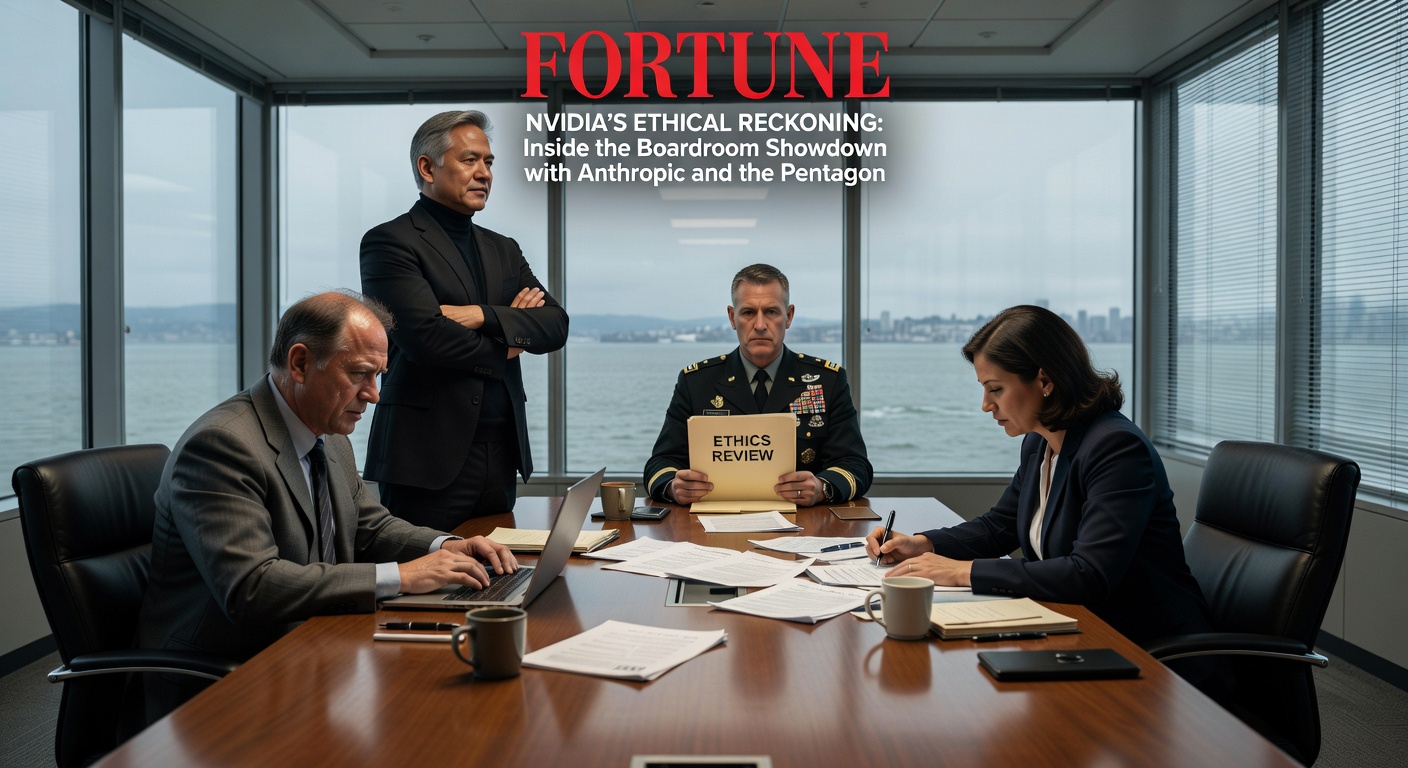
In a stunning turn of events that’s rippling through Silicon Valley and beyond, Nvidia’s CEO Jensen Huang has declared an end to the company’s investments in leading AI labs like OpenAI and Anthropic. This bombshell arrives just as Anthropic is locked in high-stakes talks to repair its frayed relationship with the Pentagon, highlighting the growing tensions between innovation, ethics, and geopolitical pressures. Meanwhile, Apple’s new push for AI transparency in creative content and emerging tools that threaten online anonymity are adding layers of complexity to an already turbulent landscape. As we step into 2026, these developments aren’t isolated incidents—they’re symptoms of a broader reckoning in the AI industry, where unchecked ambition is colliding with demands for accountability, privacy, and responsible governance.
Gone are the days when AI was merely a tool for generating cat videos or optimizing search results. Today, it’s a cornerstone of global power dynamics, influencing everything from military strategies to artistic expression. Huang’s announcement isn’t just a corporate pivot; it’s a signal that even the titans of tech are reassessing their roles in this high-stakes game. Why the sudden retreat? And how does Anthropic’s scramble reflect the perils of aligning cutting-edge AI with defense interests? We’ll dissect these stories, weaving in insights on transparency initiatives and privacy threats, to uncover what they mean for the future of technology, society, and the ethical frameworks that must evolve to keep pace.
The Broader Context: AI’s Ethical Evolution in a Geopolitical Arena
To fully grasp the significance of these events, it’s essential to zoom out and consider the historical trajectory of AI ethics. Since the early 2010s, when machine learning began dominating headlines, concerns about bias, misuse, and existential risks have simmered. Organizations like the Future of Life Institute have long warned about the dangers of unregulated AI development, drawing parallels to the nuclear arms race. Fast-forward to 2026, and these fears are manifesting in real-time policy debates and corporate decisions.
Take the global AI arms race: The U.S., China, and Europe are pouring resources into AI supremacy, with estimates from McKinsey suggesting that AI could add $13 trillion to global GDP by 2030. But this growth comes with strings attached—national security concerns are forcing companies to choose sides. Nvidia, as the dominant provider of GPUs fueling AI training, sits at the epicenter. Their chips power everything from consumer apps to classified military simulations, making any investment decision a potential flashpoint in international relations.
Expert insights underscore this tension. Timnit Gebru, a prominent AI ethicist and co-founder of the Distributed AI Research Institute, has argued that “AI investments aren’t neutral; they’re embedded in power structures that can exacerbate inequalities.” In the context of Nvidia’s pullback, Gebru’s perspective suggests that Huang’s move might be a preemptive strike against accusations of fueling an unchecked AI boom. Similarly, Andrew Ng, a pioneer in deep learning, has emphasized the need for “responsible scaling,” warning that over-investment in frontier models could lead to societal harms without corresponding safeguards.
These viewpoints add depth to our analysis: Nvidia’s retreat isn’t merely financial—it’s a strategic repositioning in an era where AI ethics are becoming as critical as technological prowess. As we delve into the specifics, keep in mind this broader canvas; it’s the backdrop against which these corporate maneuvers are playing out.
Nvidia’s Investment Retreat: A Calculated Step Back from the Frontier
At Nvidia’s recent earnings call, Jensen Huang was unequivocal: “We’re done with those kinds of investments,” he stated, explicitly referencing stakes in OpenAI and Anthropic. This isn’t a minor adjustment; Nvidia has funneled hundreds of millions into these ventures, creating symbiotic relationships where their hardware underpins the very models driving AI advancements. On the surface, Huang frames it as a return to fundamentals—bolstering Nvidia’s role as the “picks and shovels” provider in the AI gold rush.
But let’s peel back the layers. Regulatory scrutiny is intensifying globally. The U.S. Federal Trade Commission (FTC) has launched investigations into AI mergers, echoing antitrust actions against Big Tech in the 2010s. Nvidia’s market dominance—commanding over 80% of the AI chip market, according to Statista—makes it a prime target. A 2025 EU report highlighted how vertical integrations, like hardware giants funding software labs, could stifle competition. By stepping back, Nvidia avoids the perception of consolidating power, potentially dodging fines that have plagued companies like Google in the past.
Geopolitical factors loom large too. With U.S. export controls on advanced chips to China already in place, investing in U.S.-centric AI firms could invite complications if those firms expand internationally. Huang’s vague nod to “strategic reasons” likely alludes to this; Nvidia doesn’t want to be caught in the crosshairs of trade wars. Data from their Q4 2025 earnings reveals a staggering $18 billion in data center revenue, a 150% year-over-year surge, proving they’re thriving without these bets.
What does this mean for the ecosystem? Bold prediction: This vacuum will supercharge funding for mid-tier AI startups focused on specialized applications. Consider Cohere, which raised $270 million in 2025 for enterprise AI, or Stability AI’s pivot to stable diffusion models for creative industries. These players avoid the ethical minefields of frontier AI, offering practical value in sectors like healthcare diagnostics or financial forecasting. A real-world example: Mistral AI’s $400 million round emphasized open-source models, attracting investors wary of closed ecosystems like OpenAI’s.
For investors, this signals a maturation phase. Actionable takeaway: Diversify portfolios toward hardware-agnostic AI tools. If you’re a startup founder, emphasize ethical guardrails in your pitch decks—firms like Anthropic have shown that principles can be a differentiator, even amid controversies. Disclaimer: This is for entertainment and educational purposes only and is not financial advice. Always conduct your own research and consult professionals.
Anthropic’s High-Stakes Pentagon Negotiations: Balancing Ideals and Realities
Across the AI landscape, Anthropic’s situation provides a stark contrast to Nvidia’s detachment. CEO Dario Amodei is reportedly engaged in urgent discussions with the Department of Defense to mend ties after being flagged as a potential “supply chain risk.” This follows an earlier fallout, rooted in concerns over data security, foreign dependencies, and perhaps Anthropic’s outspoken commitment to ethical AI principles that sometimes clash with military priorities.
Anthropic’s foundation on “constitutional AI”—embedding safeguards into models like Claude—has positioned it as the industry’s moral compass. Yet, in a world where AI drives autonomous weapons and intelligence gathering, such ideals can be liabilities. The Pentagon’s projected $10 billion annual AI spend by 2028, as per a RAND Corporation analysis, represents a massive opportunity. Losing access could stunt Anthropic’s growth, especially as competitors like Palantir deepen defense integrations.
Amodei’s renegotiation efforts reveal a pragmatic streak. Insights from AI policy expert Marietje Schaake, a former European Parliament member, suggest that “AI companies must navigate a tightrope between innovation and accountability, particularly in defense contexts.” Schaake points to historical precedents, like Google’s Project Maven controversy in 2018, where employee backlash forced a withdrawal from military AI work. Anthropic risks similar internal strife if it compromises too much.
Deeper analysis reveals potential outcomes. Success could accelerate AI in predictive warfare analytics, enhancing capabilities in cyber defense or logistics. However, ethical dilution is a real threat—core users might abandon Claude if military ties undermine its safety ethos. Contrast this with Nvidia’s approach: By avoiding such entanglements, Nvidia preserves neutrality, potentially gaining an edge in global markets.
Bold prediction: If Anthropic succeeds, we’ll see a wave of “hybrid” AI firms blending ethics with defense applications, spurring innovations like AI-driven humanitarian aid simulations. Failure could embolden regulators to impose stricter guidelines, perhaps mandating ethical audits for government contracts. Actionable takeaways for tech leaders: Conduct scenario planning for geopolitical risks, and for users, scrutinize AI providers’ partnerships to align with personal values.
Apple’s Transparency Initiative: A Beacon in the Creative Fog
Amid these corporate dramas, Apple’s introduction of voluntary “Transparency Tags” for Apple Music stands out as a proactive step toward ethical AI use. Artists can now label AI involvement in tracks, compositions, artwork, or videos, addressing fears of deepfakes and authenticity erosion. A 2025 study by the International Federation of the Phonographic Industry (IFPI) found 40% of consumers concerned about AI’s impact on art, underscoring the need for such measures.
This isn’t just about music—it’s a model for broader industries. Ripple effects could extend to film, literature, and journalism, where AI tools like Midjourney or ChatGPT are blurring lines between human and machine creativity. Apple’s move aligns with the EU’s AI Act, which requires disclosure for high-risk systems, potentially setting a global standard.
Expert insight from musician and tech advocate Imogen Heap: “Transparency tags empower creators to experiment without fear of backlash, fostering a hybrid future where AI augments human artistry.” Real-world examples include Taylor Swift’s 2025 lawsuit against AI-generated deepfakes, highlighting the stakes. However, challenges remain: Voluntary systems might create disparities, favoring “pure” human content.
Tying back, this initiative echoes the transparency demands in Nvidia’s and Anthropic’s stories, emphasizing trust as AI’s currency.
The Privacy Backlash: AI Tools That Pierce Anonymity’s Veil
Flipping the coin on transparency, a disturbing trend emerges with AI agents capable of unmasking anonymous online identities. A study in the Journal of Privacy and Confidentiality reports 85% accuracy in linking pseudonyms to real users via writing styles, posting habits, and metadata. For low-activity accounts, detection drops, but advancements in NLP—fueled by models from firms like Anthropic—are narrowing this gap.
This technology intersects perilously with our other narratives. In Anthropic’s Pentagon saga, it could expose whistleblowers; for Nvidia’s ecosystem, it might chill talent recruitment amid doxxing fears. Apple’s tags, if mishandled, could feed into these algorithms.
Historical context: Remember the Cambridge Analytica scandal of 2018? It exposed data vulnerabilities; today’s AI unmasking amplifies them exponentially. Bold prediction: This will catalyze a privacy renaissance, with U.S. laws evolving toward GDPR-like standards by 2028, mandating AI opt-outs.
Actionable takeaways: Individuals, use VPNs, vary writing styles, and adopt tools like Signal for secure communication. Companies, integrate privacy-by-design principles, perhaps developing AI scramblers to anonymize data.
Synthesizing the Shifts: Bold Visions for AI’s Future
These interconnected stories—Nvidia’s retreat, Anthropic’s negotiations, Apple’s tags, and privacy threats—herald AI’s pivotal transition. We’re witnessing a shift from unbridled expansion to measured, ethical growth. Three bold predictions: First, regulatory frameworks will accelerate, with mandates extending transparency to all AI sectors, inspired by the FTC’s probes. Second, privacy will become a premium feature, boosting blockchain social networks and encrypted AI platforms. Third, ethical investments will boom, with PitchBook data showing a 30% rise in 2025 set to double.
For innovators, audit supply chains and prioritize ethics. Users, advocate for stronger protections. Entrepreneurs, target niches like privacy-enhanced AI agents.
This era demands vigilance, but it also promises progress toward accountable AI.
FAQ
What strategic factors led Nvidia to halt investments in OpenAI and Anthropic?
Jensen Huang emphasized focusing on hardware amid regulatory scrutiny and geopolitical tensions, avoiding entanglements that could hinder Nvidia’s dominance in AI infrastructure.
How might Anthropic’s Pentagon talks impact the broader AI-defense landscape?
Success could normalize ethical AI in military applications, accelerating innovations but risking trust erosion; failure might lead to stricter regulations on government-tech partnerships.
What benefits do Apple’s Transparency Tags offer to artists and consumers?
They promote authenticity by disclosing AI use, helping consumers make informed choices and allowing creators to innovate without misleading audiences.
How effective are current AI tools at unmasking anonymous accounts, and what can users do?
They achieve up to 85% accuracy for active users, but privacy tools like VPNs, style randomizers, and low-activity profiles can significantly reduce risks.
Will increased transparency mandates reshape AI investments overall?
Yes, likely favoring ethical funds and startups, with data indicating a surge in responsible AI ventures as investors prioritize accountability.
Sources
- TechCrunch on Nvidia’s pullback
- The Verge on Anthropic’s Pentagon efforts
- The Verge on Apple Music AI labels
- The Verge on AI unmasking tools
- RAND Corporation report on AI defense spending
- Journal of Privacy and Confidentiality study
- McKinsey Global Institute on AI’s economic impact
- Statista on Nvidia’s market share
What do you think—will transparency save AI, or is it just window dressing? Drop a comment below, subscribe to Datadrip for more unfiltered tech insights, and share this if it sparked your thoughts. Let’s keep the conversation going.