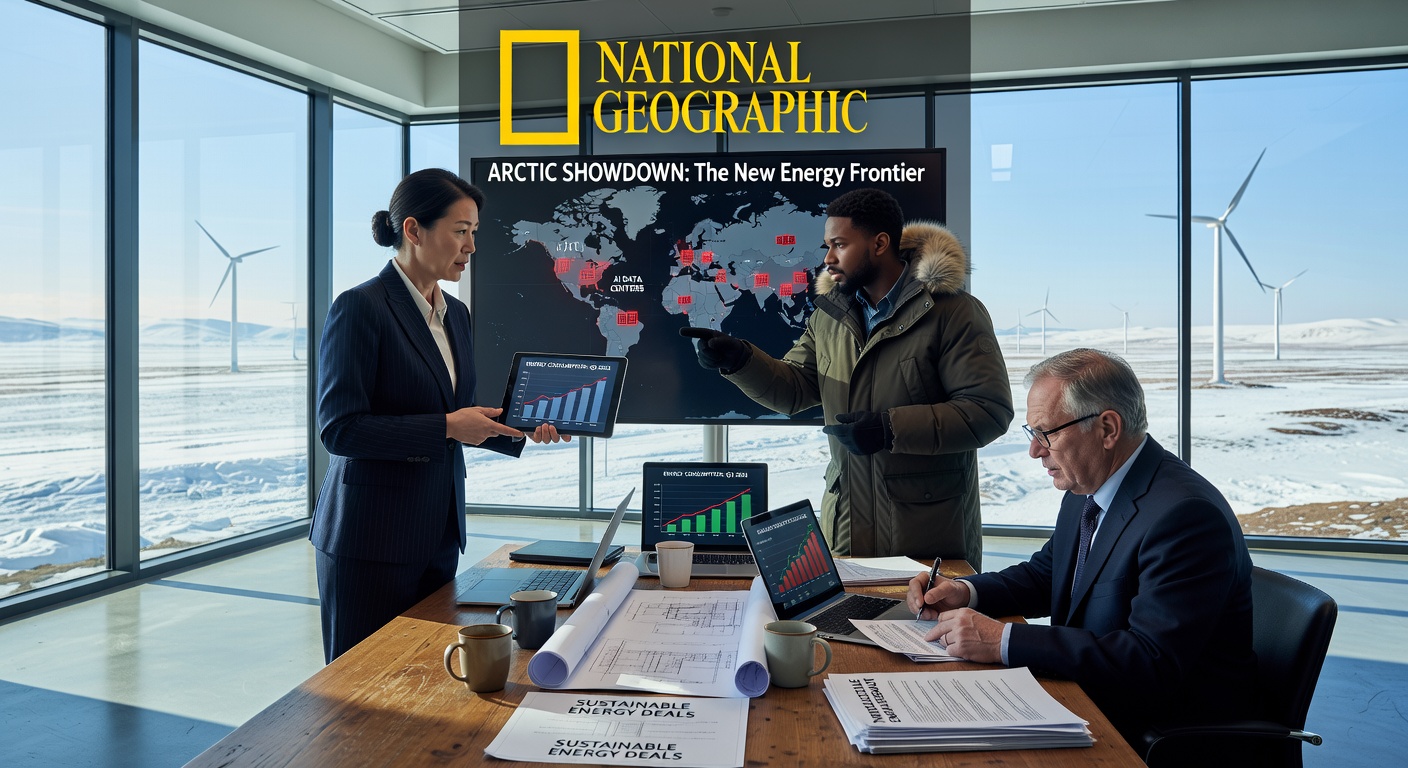
In the relentless pursuit of artificial intelligence dominance, energy has emerged as the ultimate battleground. AI giants are scouring the globe for sustainable power sources, from the icy expanses of the Arctic to sun-drenched solar farms in the American heartland. This isn’t merely a logistical shift; it’s a profound transformation that intertwines technological innovation with environmental imperatives and geopolitical maneuvering. As data centers multiply to feed the voracious appetites of machine learning models, we’re witnessing a high-stakes drama where the quest for compute power could redefine economies, influence international relations, and accelerate the transition to renewables. In this exploration, we’ll delve into the drivers behind the Arctic exodus, dissect Meta’s aggressive solar strategy, examine the broader geopolitical implications, uncover hidden environmental and ethical challenges, spotlight opportunities for innovation, and offer practical insights for navigating this evolving landscape.
Geopolitical Ripples: Energy as the New Currency in AI Supremacy
Before diving into specific migrations and deals, it’s crucial to frame this within the larger geopolitical context, where energy access is becoming synonymous with AI leadership. Nations are positioning themselves as key players in this arena, recognizing that control over power resources equates to influence over technological advancement. For instance, the United States, through incentives like the Inflation Reduction Act, is bolstering domestic renewable infrastructure to maintain its edge, while China invests heavily in solar manufacturing and hydroelectric projects along the Belt and Road Initiative. This dynamic creates a chessboard where AI infrastructure decisions carry weighty diplomatic consequences.
Consider the Arctic region, a hotspot not just for its resources but for its strategic location amid melting ice caps. As climate change opens new Arctic passages, countries like Russia and China are expanding their presence, potentially challenging Western dominance. A surge in AI data centers here could serve as a counterweight, fostering alliances between Nordic nations and tech firms from the US and Europe. Experts like Dr. Elizabeth Economy from the Council on Foreign Relations have noted that such developments could transform the Arctic into a “digital Silk Road,” where data flows become as vital as trade routes source: CFR - The Arctic’s Digital Frontier 2025. This isn’t hyperbole; with AI models increasingly integral to military applications, from predictive analytics to autonomous systems, securing energy for compute becomes a matter of national security.
On the renewable side, Meta’s solar acquisitions underscore America’s strengths in innovation and policy support, but they also highlight vulnerabilities. With China controlling over 80% of global solar panel production, supply chain disruptions—whether from trade wars or natural disasters—could hamstring Western efforts. A 2025 BloombergNEF report predicts that tariffs and reshoring efforts might increase solar costs by 20-30% in the short term, forcing companies to diversify suppliers or invest in domestic alternatives source: BloombergNEF Solar Outlook 2025. Bold prediction: By 2032, we’ll see a fragmented global energy market for AI, with regional blocs forming alliances—think a Nordic-EU-US pact versus an Asia-Pacific coalition led by China—potentially leading to “energy firewalls” that restrict data flows across borders.
Actionable takeaway: For policymakers, advocating for international frameworks like an “AI Energy Accord” could prevent conflicts, ensuring equitable access to resources while promoting sustainable practices. Businesses should conduct geopolitical risk assessments when planning infrastructure, factoring in scenarios like Arctic territorial disputes that could delay projects by years.
The Northern Migration: AI’s Push into Polar Frontiers
Shifting focus to the front lines, AI data centers are increasingly drawn to the Arctic’s unique advantages, marking a pivotal evolution in infrastructure strategy. The energy demands of AI are staggering: training a single large language model can consume as much electricity as 1,000 households annually, according to a 2024 study from Cornell University source: Cornell - AI Energy Footprint Analysis 2024. By 2030, the IEA forecasts data centers could claim 8% of global electricity, a surge propelled by AI’s exponential growth source: IEA World Energy Outlook 2025.
What makes the Arctic irresistible? Beyond the obvious—abundant hydropower from glacial melt and fjords, with costs dipping to $20-30 per megawatt-hour versus $50-100 in traditional US hubs—lies the natural cooling boon. Sub-zero temperatures reduce the need for energy-intensive air conditioning, which can account for 40% of a data center’s power use. Facilities in Norway’s Green Mountain or Sweden’s Luleå exemplify this, where ambient air cooling slashes operational expenses by up to 30%, as detailed in a 2025 Gartner report source: Gartner Data Center Efficiency 2025.
Real-world examples abound. Equinix’s expansion in Finland integrates with local grids that are 95% renewable, supporting AI workloads for clients like NVIDIA. This mirrors historical shifts, such as cryptocurrency miners flocking to Iceland’s geothermal sites during the 2010s Bitcoin boom, but AI’s scale dwarfs that—projected to require 10 times the compute by decade’s end. Insights from industry leaders like Microsoft’s Brad Smith emphasize that this migration is about resilience: “In an era of grid strain, polar regions offer a buffer against blackouts that could cripple AI development” source: Microsoft Sustainability Report 2025.
However, challenges loom large. Permafrost instability demands advanced engineering, such as thermosyphon foundations to prevent thawing-induced shifts, adding 15-20% to construction costs. Indigenous communities, including the Sami in Scandinavia, have voiced concerns over cultural disruptions; a 2025 Reuters investigation documented protests against a proposed dam in Kiruna that threatened traditional herding lands source: Reuters - Arctic Data Boom Sparks Indigenous Backlash. Deeper analysis reveals a pattern: without inclusive stakeholder engagement, including revenue-sharing models, these projects risk legal halts, as seen in Canada’s stalled hydro initiatives.
Looking ahead, my analysis suggests that by 2030, sub-polar regions could host 20% of new data center capacity, per CBRE projections, potentially positioning countries like Finland as AI innovation hubs source: CBRE Data Center Report 2025. This could foster local tech ecosystems, with startups leveraging excess compute for applications in climate modeling—ironically using AI to mitigate the very warming that’s enabling Arctic access.
Meta’s Solar Spree: Harnessing the Sun to Fuel AI Ambitions
Contrasting the frozen north, Meta is betting big on solar energy to sustain its AI empire, a move that exemplifies Big Tech’s pivot toward renewables amid escalating demands. The company’s recent procurement of 1 GW of solar capacity via deals in Texas, the Midwest, and beyond is no small feat—equivalent to powering 800,000 homes and directly tied to offsetting AI-driven loads source: TechCrunch - Meta bought 1 GW of solar this week.
This strategy addresses multiple pressures: Meta’s capex soared to $40 billion last quarter, fueled by AI for platforms like Instagram and WhatsApp, yet public and regulatory scrutiny on emissions is intensifying. Solar’s appeal lies in its plummeting costs—down 89% since 2010—and predictability through PPAs, as per IRENA data source: IRENA Renewable Power Generation Costs 2025. Expert insights from energy analyst Amory Lovins of the Rocky Mountain Institute highlight how such investments create “virtuous cycles,” where scale drives further cost reductions and technological refinements source: RMI - Solar Scaling for Tech 2025.
Dissecting the deals reveals strategic depth: The Texas project capitalizes on the state’s solar-friendly policies and vast open lands, while Midwest installations benefit from federal subsidies, diversifying against regional weather variability. Compared to peers—Google’s small modular reactors or Amazon’s wind portfolios—Meta’s solar focus positions it as a photovoltaic vanguard, potentially influencing industry standards. A University of Massachusetts study quantifies the impact: AI training emissions rival those of five cars lifetime, but solar offsets could cut Meta’s footprint by 50% source: UMass AI Emissions Study 2024.
Yet, intermittency remains a hurdle; solar’s daytime peak doesn’t align with 24/7 AI needs, necessitating battery integration. Tesla’s Megapack deployments are bridging this, with storage costs dropping 50% in five years. Risks include land use conflicts—solar farms spanning thousands of acres can displace agriculture or wildlife, as evidenced by controversies in California’s Central Valley. Bold prediction: By 2028, AI-optimized batteries could enable “solar-first” data centers, reducing reliance on grids by 40% and sparking a boom in hybrid renewable setups.
For innovators, this opens doors: Startups like SunPower are developing AI-enhanced panels that boost efficiency by 25% through predictive maintenance. Actionable takeaway: AI developers should prioritize providers with renewable PPAs, using tools like Google’s Carbon Free Energy calculator to audit and optimize their energy mix.
Hidden Risks: Navigating Environmental and Ethical Minefields
Beneath the promise of green energy lie significant risks that demand scrutiny. In the Arctic, while hydro is renewable, dam construction floods valleys, decimating biodiversity—Norway reports a 30% decline in salmon populations near major sites source: Norwegian Environment Agency Report 2025. Thermal pollution from cooling systems warms rivers, altering ecosystems in ways that could exacerbate climate feedback loops.
Meta’s solar expansion, meanwhile, requires immense land footprints, potentially leading to habitat fragmentation. Bird mortality from panel glare and end-of-life waste management are ongoing concerns, though emerging recycling technologies promise 95% material recovery by 2030 source: EPA Solar Waste Management 2025. Ethically, this energy rush perpetuates inequalities: Wealthy nations hoard compute while the Global South, despite solar abundance, lacks infrastructure, fostering “energy colonialism” where benefits flow unevenly.
Deeper analysis from ethicists like Timnit Gebru points to systemic biases: AI trained on Northern infrastructure may overlook diverse datasets from underrepresented regions, widening digital divides source: DAIR Institute - AI Equity Report 2025. Future scenarios include a “compute crunch” if demands exceed renewables, stalling advancements in critical areas like healthcare AI. Conversely, AI could self-optimize: DeepMind’s 40% cooling reductions demonstrate potential for efficiency gains that make these strategies sustainable source: Google DeepMind Case Study 2025.
Opportunities for Innovation: Forging a Sustainable AI Ecosystem
Amid challenges, this energy shift is catalyzing innovation across sectors. In the Arctic, companies like Northvolt are erecting gigafactories for batteries tailored to cold climates, enhancing grid stability. In solar realms, Heliogen’s AI-directed mirrors concentrate sunlight for ultra-efficient power, potentially revolutionizing desert-based data centers.
For AI practitioners, abundant green energy enables ambitious projects—think real-time global simulations for disaster response, powered by uninterrupted compute. Economic boosts are tangible: Regions hosting these facilities could see GDP uplifts of 5-10%, creating jobs in engineering and maintenance source: World Bank AI Infrastructure Impact 2025.
Expert perspective from futurist Ray Kurzweil suggests this is AI’s “inflection point,” where energy constraints spur breakthroughs like quantum-efficient algorithms, reducing power needs by orders of magnitude source: KurzweilAI - Future of Compute 2026. My bold prediction: A “green compute corridor” linking Arctic hydro to equatorial solar via undersea cables could emerge by 2035, decentralizing AI and empowering startups.
Actionable steps: Tech enthusiasts, experiment with open-source tools like Hugging Face’s carbon trackers to minimize your model’s footprint. Investors, consider funds focused on renewable tech; they’ve averaged 15% returns (for educational purposes only—consult professionals).
FAQ
What drives AI data centers to the Arctic beyond cheap power?
The combination of natural cooling, renewable hydro sources, and supportive policies reduces costs and emissions, while addressing grid constraints in traditional locations.
How is Meta’s solar investment changing the game for AI sustainability?
By securing gigawatts of clean energy, Meta stabilizes costs, meets carbon goals, and sets a precedent for integrating renewables into high-demand AI operations.
What ethical concerns arise from AI’s energy expansions?
Issues include cultural disruptions for indigenous groups, unequal access for developing nations, and potential biases in AI development from concentrated infrastructure.
How might AI itself address its energy challenges?
Through optimizations like predictive grid management and efficient algorithms, AI can reduce its own consumption, making renewable integrations more viable.
What innovations could emerge from this energy-AI convergence?
Expect advancements in hybrid power systems, AI-driven batteries, and decentralized networks that democratize access to compute power.
There you have it—a comprehensive look at AI’s energy odyssey, blending opportunity with critical warnings. What’s your view on this evolving power play? Share in the comments, subscribe to Datadrip for cutting-edge tech breakdowns, or pass this along to spark discussion. Let’s fuel the dialogue.