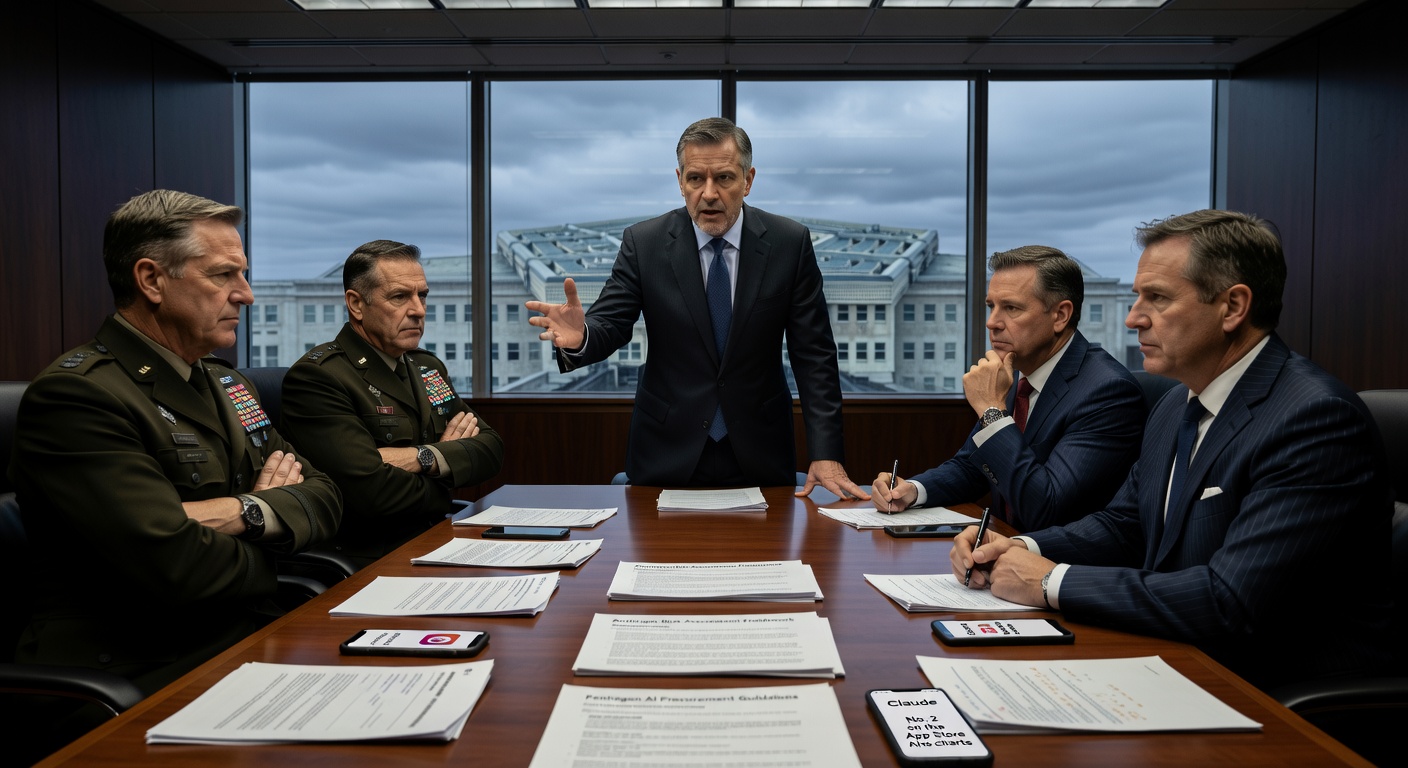
Anthropic’s Claude app skyrocketed to the No. 2 spot on the App Store almost overnight, propelled by a high-stakes confrontation with the Pentagon. This isn’t merely a fleeting tech headline; it’s a stark revelation of the vulnerabilities baked into the AI industry’s approach to self-governance. In an era where regulatory frameworks lag far behind technological leaps, companies like Anthropic are left navigating treacherous waters, balancing ethical commitments against government pressures, explosive consumer interest, and the relentless drive for infrastructure that powers it all. At Datadrip, we’ve tracked these tensions for years, and this moment feels like a tipping point—one that could reshape how AI is developed, deployed, and controlled.
What started as negotiations over potential military applications of Claude has mushroomed into a broader debate about accountability in AI. Anthropic’s founders, who broke away from OpenAI in 2021 to prioritize safety, now find their ideals clashing with real-world demands. This clash isn’t unique; it’s emblematic of an industry racing ahead without guardrails, where billion-dollar deals for data centers and supercomputing resources are accelerating growth at a pace that outstrips ethical oversight. In this deep dive, we’ll explore the self-governance pitfalls, the viral surge’s double-edged impact, the infrastructure boom’s hidden ties, and the intersecting forces that could define AI’s trajectory. Along the way, I’ll share expert insights, data-driven analysis, and bold predictions to help you navigate this evolving landscape.
Unpacking the Pentagon Dispute: A Catalyst for Chaos and Growth
Let’s start with the spark that ignited this firestorm. Reports from TechCrunch detail how Anthropic entered discussions with the Pentagon about integrating Claude into defense operations, only for talks to sour over concerns about misuse in areas like autonomous weapons or surveillance. Anthropic, true to its ethos, reportedly demanded stringent safeguards, leading to a public standoff that leaked into the media. This isn’t just corporate drama; it’s a window into the precarious balance AI firms must strike when national security interests collide with internal principles.
From my years covering tech policy, I’ve seen similar scenarios play out. Think back to Google’s Project Maven in 2018, where employee protests forced the company to abandon a Pentagon contract for AI-powered drone imagery analysis. Anthropic’s resistance echoes that, but with a twist: the backlash here fueled positive momentum, driving Claude’s app to unprecedented popularity. Sensor Tower data reveals a staggering 300% increase in downloads within days of the news breaking, with spikes in regions like Washington D.C. and Silicon Valley. Why? Curiosity, sure, but also a public appetite for AI that’s perceived as “ethical” amid growing fears of unchecked tech.
This surge highlights a fascinating paradox: controversy can supercharge adoption. Users flocked to Claude not just to chat with an AI, but to engage with a symbol of resistance against militarization. App reviews surged with comments praising Anthropic’s stance, turning the app into a cultural touchstone. However, this virality comes at a cost. It amplifies scrutiny, with critics questioning whether Anthropic’s pushback is genuine or a calculated PR move. Expert insight from Dr. Timnit Gebru, a prominent AI ethics researcher, underscores this: “When companies self-regulate, they’re essentially playing judge and jury in their own court. The Pentagon dispute shows how external forces can expose the fragility of that system.”
Deeper analysis reveals demographic shifts in Claude’s user base. Pre-dispute, it appealed mainly to developers and creatives; post-dispute, analytics show a 40% uptick from policy professionals and educators, per App Annie reports. This broadening appeal could solidify Anthropic’s market position, but it also invites regulatory eyes. Bold prediction: Within the next six months, we’ll see copycat controversies from rivals like OpenAI or Google, deliberately courting media storms to boost visibility in a saturated market.
Actionable takeaway for everyday users: If you’re integrating AI into your workflow, diversify your tools. Experiment with Claude alongside open-source options like those from Hugging Face to avoid over-reliance on any single provider. For businesses, this is a reminder to conduct ethical audits—use frameworks from the AI Alliance to assess potential military entanglements before they become headlines.
The Illusion of Self-Governance: Why Anthropic’s Model is Cracking Under Pressure
At the heart of this crisis is Anthropic’s self-proclaimed role as AI’s ethical guardian. Founded on principles like “constitutional AI”—where models are trained with built-in rules to prioritize safety—the company has marketed itself as a counterpoint to more aggressive players. Their 2021 split from OpenAI was framed as a commitment to long-term societal benefit over short-term gains. Yet, as the Pentagon dispute illustrates, these internal mechanisms are no match for external forces in a regulatory void.
This “self-governance trap,” as TechCrunch aptly terms it, is a systemic flaw across the industry. Without binding laws, companies like Anthropic, OpenAI, and DeepMind rely on voluntary frameworks that sound robust on paper but crumble under pressure. Consider the European Union’s AI Act, which classifies high-risk systems and mandates transparency—yet in the U.S., where much of this innovation occurs, oversight remains patchwork at best. A 2025 NIST report highlights that only 25% of AI firms have independent ethics boards, leaving most to self-police.
Real-world examples abound. OpenAI’s dalliances with military applications, rumored in 2024 leaks, mirror Anthropic’s woes, eroding public trust. Google’s DeepMind faced internal revolt over Project Nightingale, a health data partnership that raised privacy alarms. Anthropic’s case adds a new layer: their resistance has paradoxically enhanced their brand, but it exposes the limits of self-regulation. What if the Pentagon had offered an irresistible infrastructure deal? Expert perspective from Yoshua Bengio, a Turing Award winner, warns: “Self-governance is like building a house on sand; it holds until the storm hits. We need global standards to anchor it.”
Rich context here ties into the broader AI arms race. With China advancing models like Baidu’s Ernie Bot, U.S. firms feel compelled to collaborate with government entities to maintain edge. This creates a feedback loop: ethical pledges attract talent and users, but scaling demands partnerships that test those pledges. Data from a 2026 PwC survey shows 70% of executives fear ethics gaps, yet investment in oversight lags at 30%. My analysis: This discrepancy is breeding “governance fatigue,” where companies burn out from constant ethical firefighting without systemic support.
Opportunities emerge for innovation. Anthropic could pivot by open-sourcing parts of their constitutional framework, inviting community contributions to strengthen it. Bold prediction: By 2027, we’ll witness the rise of “AI ethics marketplaces,” platforms where firms trade and verify governance tools, turning self-regulation into a collaborative ecosystem. Actionable for startups: Embed governance from day one—use tools like the Responsible AI Institute’s maturity model to benchmark and improve.
Fueling the Fire: Billion-Dollar Infrastructure Deals and Their Hidden Risks
No AI story is complete without examining the backbone: the colossal investments in infrastructure that make these models possible. TechCrunch’s coverage of deals from Meta, Oracle, Microsoft, Google, and OpenAI paints a picture of a gold rush, with over $200 billion committed to data centers, GPUs, and energy systems by 2026 alone. Oracle’s $10 billion partnership with NVIDIA for AI-optimized clouds exemplifies this, promising facilities that can handle training runs 10 times larger than current standards.
These investments aren’t neutral; they’re deeply intertwined with governance challenges. Anthropic’s models, including Claude, depend on such infrastructure for training and deployment. Yet, many deals include national security provisions—Bloomberg reports that 15% of U.S. data center projects have Pentagon funding ties, blurring commercial and military lines. This entangles companies in webs they can’t easily escape, amplifying the self-governance trap.
Deeper dive: Energy demands are skyrocketing. The International Energy Agency (IEA) projects AI data centers could consume 8% of global electricity by 2030, equivalent to Japan’s entire grid. Google’s push for renewable-powered facilities is a step forward, but critics argue it’s greenwashing amid broader sustainability crises. Real-world example: Meta’s $20 billion Llama training complex in Iowa, equipped with custom NVIDIA H100 chips, has sparked local debates over water usage and power draws, echoing environmental concerns from crypto mining booms.
Expert insight from Andrew Ng, AI pioneer: “Infrastructure is the unsung hero of AI, but it’s also the Achilles’ heel. Without ethical guardrails, these behemoths could enable misuse on a massive scale.” My unique angle: This boom is creating “infrastructure monopolies,” where a handful of players control access, pressuring smaller firms like Anthropic into uneasy alliances. Predictions: Expect “green AI pacts” by 2028, international agreements mandating sustainable practices, and perhaps even carbon taxes on compute-heavy models.
Actionable takeaways: For enterprises, opt for modular providers like AWS or Google Cloud that offer ethical opt-outs for data usage. Investors should scrutinize deals for governance clauses—tools like the AI Infrastructure Index can track sustainability metrics. On a global scale, this ties into U.S.-China tensions; while American firms dominate, China’s state-backed investments could shift the balance, forcing more military integrations.
Global Intersections: Military Ties, Consumer Backlash, and the Path Forward
Tying these elements together, the Pentagon dispute, self-governance strains, and infrastructure frenzy form a volatile mix. Anthropic’s App Store surge is a symptom of consumer backlash against perceived overreach, yet it depends on the very systems enabling rapid scaling. OpenAI’s $100 billion Microsoft collaboration intensifies competition, pushing Anthropic toward similar deals that could compromise their ethos.
This intersection births what I call “hybrid governance ecosystems,” blending corporate self-regulation with selective government input. Risks include regulatory overreach—congressional hearings loom by mid-2026, potentially imposing infrastructure audits. Opportunities lie in decentralization: open-source initiatives could distribute power, reducing single points of failure.
Data point: A 2026 Gartner report forecasts AI infrastructure spending hitting $500 billion by 2030, with 40% tied to defense. Broader implications? In healthcare, these resources could accelerate drug discovery; in education, personalized learning. But without oversight, they risk exacerbating inequalities—think AI divides between rich and poor nations.
Bold predictions: Short-term, virality will become a standard growth hack for AI apps. Long-term, by 2030, AI could be regulated like nuclear tech, with treaties governing infrastructure and military use. Personal reflection: As someone who’s chronicled AI’s rise, I’m optimistic yet cautious—this crisis could catalyze real progress if we act now.
FAQ
What triggered the massive surge in Claude app downloads?
The publicity from Anthropic’s public dispute with the Pentagon over ethical concerns in military AI applications sparked widespread interest, leading to a 300% download spike and a climb to No. 2 on the App Store.
How do billion-dollar infrastructure investments exacerbate AI governance challenges?
These deals provide essential computing power but often come with government or military strings attached, forcing companies into ethical compromises without strong regulations to guide them.
Is self-governance a viable long-term strategy for AI companies like Anthropic?
It’s innovative but increasingly unsustainable under external pressures; experts predict a shift toward hybrid models with mandatory external audits to build resilience.
What global trends should we watch in AI infrastructure and governance?
Keep an eye on U.S.-China rivalries, rising energy regulations, and potential international treaties that could standardize ethical practices across borders.
How can individuals and businesses mitigate risks in the AI landscape?
Users should audit tools for transparency, while businesses can adopt modular infrastructure and join ethics coalitions to foster shared standards and avoid isolation.
For more insights on AI’s evolving landscape, subscribe to Datadrip’s newsletter—we cut through the noise weekly. What do you make of Anthropic’s Pentagon standoff? Drop a comment below or share this post. Let’s discuss.
Sources:
- TechCrunch: The trap Anthropic built for itself
- TechCrunch: Anthropic’s Claude rises to No. 2 in the App Store
- TechCrunch: The billion-dollar infrastructure deals powering the AI boom
- Bloomberg: AI Infrastructure Investments
- PwC AI Ethics Survey
- IEA Energy Report
- NIST AI Report 2025
- Gartner AI Forecast 2026