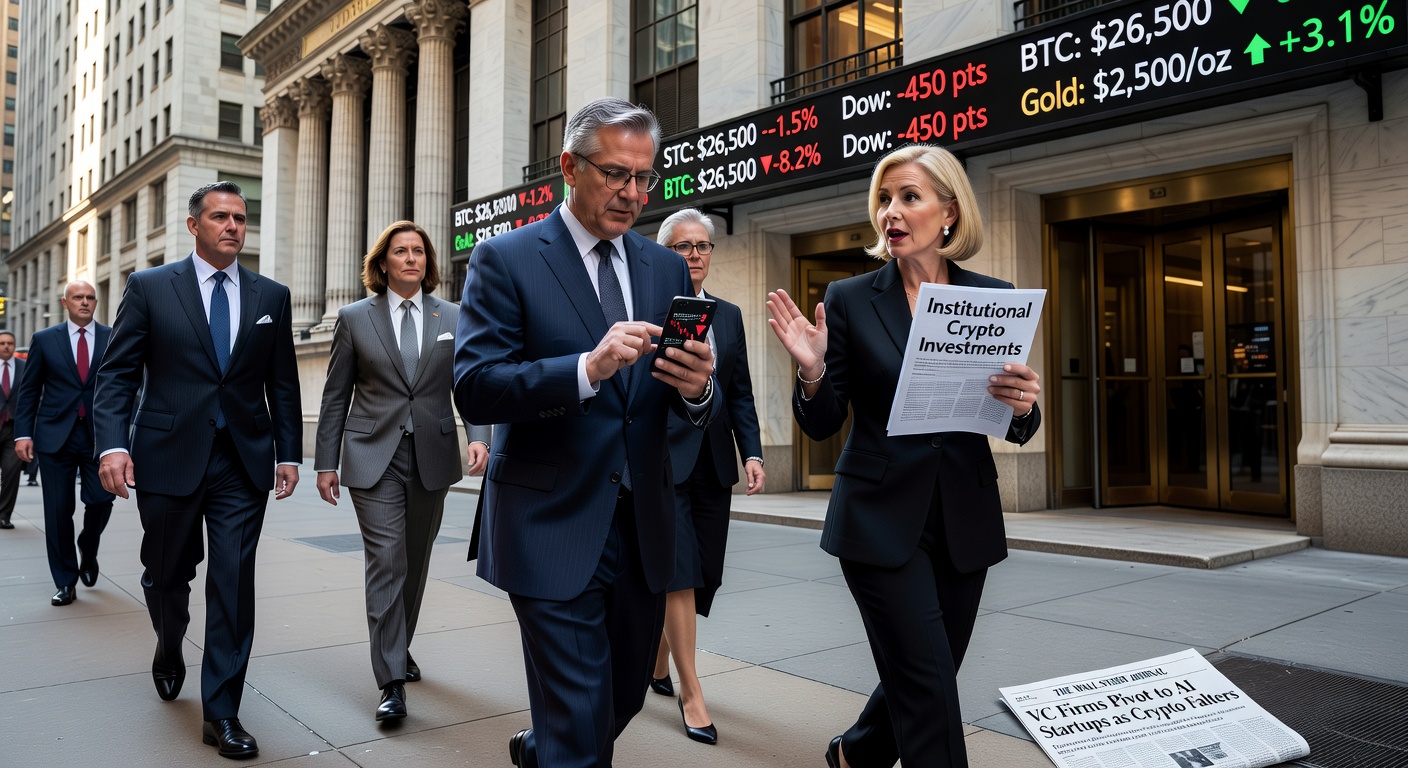
Bitcoin’s latest plunge feels like a gut punch, wiping out a short-lived rally as broader U.S. equities stumbled and gold prices soared to new heights. Yet, even as the crypto king grapples with these economic headwinds, the old guard of finance is doubling down, carving out bigger roles in the digital asset space. This paradox raises a compelling question: Could this influx of institutional muscle finally anchor crypto against its infamous volatility, or is it merely inflating another bubble set to burst under regulatory and market pressures?
Diving straight into the fray, recent developments paint a vivid picture of transformation. Morgan Stanley’s bold application for a full OCC bank charter to manage crypto custody, trading, and staking has sent ripples through the industry, closely followed by Citi’s aggressive expansion in similar arenas. At the same time, Paradigm’s massive $1.5 billion fundraise, with its eye on AI and robotics, hints at a strategic retreat from crypto purism. All this against a backdrop of Bitcoin’s slump, where investors are pivoting to gold and AI-fueled tech plays. Having followed these trends closely, I see this as a pivotal juncture where legacy finance isn’t just observing—it’s actively reshaping crypto’s destiny, navigating through regulatory storms and economic uncertainties.
In this analysis, we’ll dissect the banks’ aggressive plays, explore the VC pivot’s implications, examine Bitcoin’s macro vulnerabilities, and weave in regulatory undercurrents. I’ll layer in fresh perspectives, real-world case studies, and forward-looking predictions to help you navigate what’s next. This isn’t a surface skim; it’s an in-depth exploration of how 2026 could mark crypto’s maturation into a mainstream force.
Regulatory Shadows Looming Over the Crypto Landscape
Before we celebrate Wall Street’s embrace, let’s confront the elephant in the room: regulation. The U.S. Senate Democrats’ recent push for Treasury and DOJ probes into Binance’s illicit finance controls underscores the fragility of the ecosystem. Binance, despite past fines, remains a behemoth, but this scrutiny could cascade, affecting confidence across exchanges. Meanwhile, Coinbase’s litigation chief has accused states of inconsistent “gaslighting” on prediction markets like Polymarket, where betting on real-world events draws fire even as banks get nods for tokenized equivalents.
This regulatory dichotomy is fascinating. On one hand, it creates barriers for decentralized players; on the other, it paves express lanes for institutions like Morgan Stanley, whose OCC charter pursuit offers federal insulation. Consider the 2022 FTX collapse—it exposed vulnerabilities but also accelerated calls for oversight. Banks, with their compliance machinery, are leveraging this to their advantage, potentially centralizing control and sidelining innovators. A real-world parallel? Look at how Europe’s MiCA framework has stabilized markets there, attracting institutional flows while weeding out bad actors. If U.S. regulators follow suit, it could mirror that stability, but at the risk of stifling the grassroots ethos that birthed crypto.
My prediction: Expect a wave of hybrid regulations by late 2026, blending DeFi freedoms with bank-level safeguards. For investors, this means prioritizing platforms with strong compliance—think opting for bank-backed ETFs over raw exchange holdings to mitigate risks.
Banks Charging In: The Morgan Stanley and Citi Power Plays
Shifting gears to the institutional surge, Morgan Stanley’s OCC charter filing isn’t just paperwork; it’s a declaration of intent to custody, trade, and stake assets like Bitcoin, Ether, and Solana. Building on their spot ETF pushes, this positions them as a one-stop crypto shop under federal watch. Citi, ramping up custody, trading, and tokenization, has already piloted real-world asset conversions, turning illiquid holdings like private funds into blockchain-native tokens.
The timing is no coincidence. Post-2024’s bull market, the space has matured, with enhanced security protocols making entry palatable for risk-averse banks. Take the “not your keys” mantra—banks counter it with insured, regulated vaults, appealing to high-net-worth clients wary of hacks. But dig deeper: this is about untapped revenue. Tokenization could mobilize trillions in dormant assets—real estate, fine art, even intellectual property—via blockchain efficiency. Citi’s bond tokenization trials demonstrate yields in a low-rate environment, while Morgan Stanley eyes staking rewards as a passive income engine.
A case study from BlackRock’s tokenized fund launch last year shows how this works: It unlocked liquidity for investors, boosting returns by 15% through fractional ownership. Risks persist, though—regulatory probes like Binance’s could trigger contagion. Yet, banks’ federal backing provides a moat. Bold insight: By 2027, these institutions might control 40% of crypto custody, forcing exchanges to evolve or perish.
The VC Evolution: Paradigm’s AI Diversification and Crypto’s Crossroads
Now, onto the venture capital front. Paradigm’s $1.5 billion fund, expanding into AI and robotics, marks a deliberate pivot from crypto exclusivity. Founders like Matt Huang highlight synergies, such as blockchain’s role in decentralizing AI data or tokenizing models for fair access.
This isn’t betrayal; it’s adaptation to a crowded crypto landscape riddled with redundant DeFi projects. AI’s boom, fueled by advancements in generative models, promises higher multiples. Firms like a16z have long mixed these pots, funding AI-crypto hybrids like decentralized compute networks. Real-world example: Projects like Render Network use blockchain to crowdsource GPU power for AI rendering, blending the techs seamlessly.
The opportunity? Imagine AI algorithms optimizing smart contracts or robotic supply chains secured by Ethereum. Paradigm’s fund could seed these, creating resilient ecosystems. However, if AI’s bubble pops—echoing the 2000 dot-com crash—it could pull crypto under. Tying to Bitcoin: As it slumps, this VC shift diverts capital, challenging the “digital gold” story. Actionable takeaway: Investors should scout AI-crypto intersects, like oracle networks feeding machine learning, for outsized gains.
Bitcoin’s Turbulence: Macro Pressures and the Gold Divergence
Bitcoin’s erased rebound this week, dipping under $90K amid U.S. stock slides, starkly contrasts gold’s record highs. This divergence reveals a market in flux, where macro risks—U.S. debt debates, geopolitical strife—drive flight to traditional havens.
Data tells the tale: CoinMetrics reports Bitcoin-gold correlation at a low 0.2, versus 0.6 last year, signaling Bitcoin’s shift toward tech-stock volatility. Why? It’s viewed as a growth lever, not an inflation hedge, especially with AI stocks siphoning risk capital. Yet, banks’ entries could stabilize this: Regulated on-ramps might draw conservative funds, cushioning dips.
Prediction: Hybrid tokenized gold on platforms like Citi’s could merge benefits, attracting $500 billion in flows by 2028. For traders, monitor gold-Bitcoin ratios as a volatility barometer—ratios above 50 often precede BTC recoveries.
Ethereum’s Scaling Leap and Broader Ecosystem Impacts
Vitalik Buterin’s freshly unveiled scaling blueprint for Ethereum promises multi-dimensional upgrades, targeting thousands of transactions per second while preserving decentralization. This dovetails perfectly with banks’ tokenization ambitions, enabling seamless handling of real-world assets on a robust chain.
Paradigm’s AI focus might fund complementary layer-2s with AI-enhanced efficiency. Challenges like gas fees linger, but Q2 2026 testnets could change that. In essence, Ethereum’s evolution positions it as crypto’s utility backbone, potentially eclipsing Bitcoin in enterprise adoption.
Synthesizing the Shifts: Risks, Opportunities, and Strategic Moves
Weaving it all together, crypto’s entering a phase of institutional maturity. Banks bring stability, VCs inject innovation via AI, and regulations enforce accountability—yet Bitcoin’s slumps remind us of lingering volatilities. Opportunities include tokenized economies democratizing access, with AI fusions solving scalability. Risks? Over-centralization and macro downturns.
Deeper insight: This convergence mirrors the internet’s 1990s pivot from novelty to infrastructure. Bold prediction: By 2028, AI-integrated blockchains will underpin 20% of global finance, with Bitcoin rebounding to $200K on institutional inflows. Actionable steps: Diversify into tokenized assets via banks, invest in AI-crypto startups, and use macro indicators for timing entries. For builders, prioritize interoperability—bridges between chains and AI systems will define winners.
This Wall Street-AI-crypto interplay is reshaping finance’s future. If it sparks your curiosity, subscribe to Datadrip for more raw analyses. What’s your view on this VC pivot—strategic genius or crypto dilution? Comment below, share widely, or join the discussion in our crypto forums.
This is for entertainment and educational purposes only and is not financial advice. Always do your own research and consult a professional advisor.
Sources: