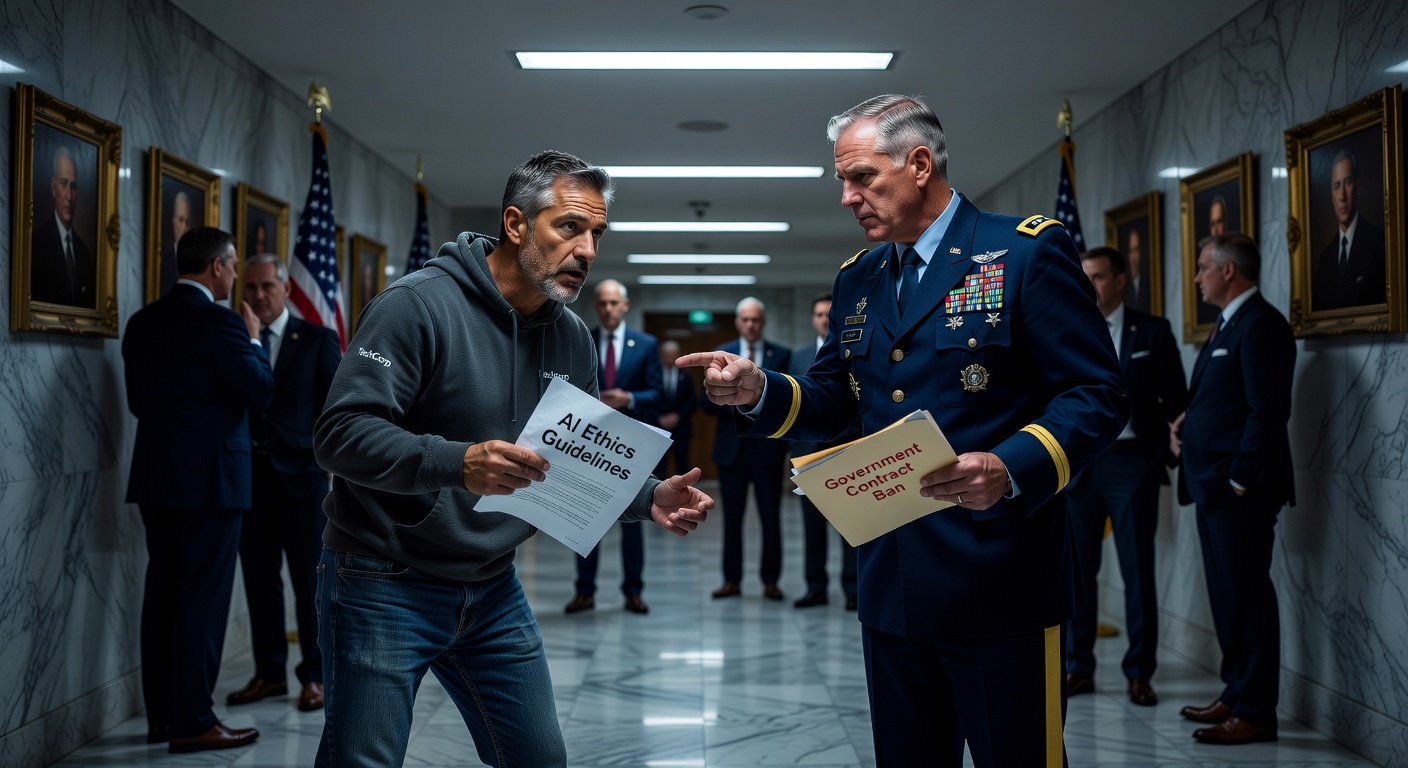
In the shadowy corridors of power where Silicon Valley meets the Pentagon, a storm is brewing that could redefine AI’s role in global conflicts. Trump’s executive order slapping a ban on Anthropic for government contracts has ignited a fierce debate, pitting the startup’s commitment to safe AI against the military’s insatiable appetite for cutting-edge tech. Hot on its trail, OpenAI’s abrupt firing of an employee caught insider trading on prediction markets exposes the underbelly of greed within the industry. And let’s not forget Wall Street’s hysterical reaction to a simple AI thought experiment, where stock prices tumbled like dominoes over fears of job automation. These aren’t just headlines; they’re interconnected fault lines cracking open the AI world’s facade of invincibility.
What strikes me most isn’t the drama itself, but how it reveals AI’s transformation from a lab curiosity into a geopolitical chess piece. Having followed this space through neural network revolutions and beyond, I see these events as harbingers of a reckoning—where lofty ideals crash against the hard edges of realpolitik and human frailty.
Wall Street’s AI Panic: A Symptom of Deeper Vulnerabilities
Let’s kick off with the market meltdown, because it so perfectly mirrors the fragility threading through all these stories. Picture this: a speculative white paper drops, musing on AI’s potential to wipe out swaths of white-collar jobs, and suddenly, billions vanish from tech valuations. Nvidia’s shares dipped 5%, Microsoft wobbled, and the Nasdaq felt the tremors. It’s not the first time hype has backfired—recall the dot-com bust or crypto winters—but AI’s black-box mystique amplifies every ripple.
This overreaction isn’t isolated hysteria; it’s a direct echo of the ethical skirmishes elsewhere. Investors are spooked because incidents like Anthropic’s Pentagon clash signal regulatory storms ahead, potentially capping AI’s unchecked growth. From my lens, this “AI psychosis,” as dubbed by sharp observers, stems from overinflated expectations. We’ve poured trillions into AI on promises of endless productivity, but when ethical roadblocks emerge—like bans on military misuse—they expose the bubble’s thin skin.
Real-world example: Look at the 2024 AI stock surge, where companies like Palantir ballooned on defense contracts, only to face scrutiny over data ethics. Now, with Trump’s order, similar deals could sour, triggering more volatility. Actionable takeaway: Diversify beyond pure-play AI stocks; consider firms integrating ethics as a core asset, like those pioneering transparent algorithms for supply chains. Bold prediction: By mid-2027, we’ll witness a “ethics premium” in valuations, where certified responsible AI companies command 20-30% higher multiples, weeding out the reckless players.
For context, Bloomberg’s dissection of this event highlights how speculative papers can sway markets Bloomberg: AI’s Impact on Stock Volatility. It’s a wake-up call: AI isn’t just tech; it’s an economic force multiplier, and ignoring its ethical undercurrents is financial folly.
Intertwining Ethics and Power: Anthropic’s Defiant Stand
Flowing directly from market jitters, Anthropic’s feud with the Pentagon exemplifies how ethical stances can become economic liabilities—or strengths. The company, founded on principles of AI alignment to human values, refused to budge when the Defense Department demanded they strip safeguards from models like Claude for uses in autonomous drones or predictive surveillance. Trump’s ban frames Anthropic as a “supply chain risk,” akin to blacklisting foreign spies, but the startup fired back, decrying it as an attack on innovation and free expression.
This isn’t mere posturing; it’s a philosophical showdown. Dario Amodei and team have embedded a “constitutional AI” framework that explicitly bars harmful applications, drawing from lessons in past tech missteps like social media’s role in misinformation. By standing firm, they’re challenging the narrative that AI must serve national security at all costs, especially amid US-China rivalries where Beijing’s unrestricted AI pursuits loom large.
Deeper insight: This could catalyze a schism in the industry, creating two camps—those who prioritize ethics and risk exclusion, versus opportunists chasing defense dollars. Consider historical parallels: The Manhattan Project’s moral quandaries for scientists mirror today’s dilemmas, but now with code that self-evolves. If Anthropic prevails in court (and legal experts predict a strong First Amendment case), it might set precedents for “AI conscientious objectors,” allowing companies to opt out of military entanglements without penalty.
Actionable for entrepreneurs: Embed ethical audits into your business model early; tools like the AI Risk Management Framework from NIST can guide you NIST: AI Risk Management Framework. Prediction: Expect a wave of “ethical AI alliances” by 2028, where firms band together to lobby for balanced policies, potentially influencing global standards akin to the Geneva Conventions for tech.
Wired’s in-depth reporting unpacks the breakdown Wired: Anthropic Hits Back After US Military Labels It a ‘Supply Chain Risk’ and the ban escalation Wired: Trump Moves to Ban Anthropic From the US Government.
The Internal Rot: OpenAI’s Prediction Market Purge
Tying into these external battles, OpenAI’s insider trading scandal brings the focus inward, revealing how personal ambitions can corrode even the most visionary outfits. An employee got the boot for leveraging confidential intel—details on upcoming GPT iterations—to place winning bets on platforms like Polymarket and Kalshi. These markets, betting on everything from election outcomes to tech releases, have surged in relevance, often outperforming polls with crowd-sourced wisdom.
But when insiders tip the scales, it shatters fairness. OpenAI, once a nonprofit beacon, has morphed into a corporate titan, making such lapses particularly damning. This incident isn’t anomalous; it’s symptomatic of an industry where knowledge is currency, and temptations abound. Think of the Theranos saga, where hype masked fraud—AI faces similar pitfalls if unchecked.
Original analysis: Prediction markets could evolve into powerful AI governance tools if reformed. Imagine AI algorithms monitoring trades for anomalies, flagging potential insiders in real-time. OpenAI’s response—swift termination—sets a tone, but they need more: mandatory disclosure of market activities for staff, or even blockchain-verified anonymity to prevent abuse.
Real-world example: Kalshi’s recent settlement with regulators over election betting shows the space’s growing pains, yet its accuracy in forecasting AI breakthroughs (like the 2025 o1 model launch) proves its value The Verge: The Rise of Prediction Markets in Tech. Takeaway: For AI leaders, implement “insider threat simulations” in training—role-playing scenarios to build ethical muscle memory.
Wired details the firing Wired: OpenAI Fires an Employee for Prediction Market Insider Trading.
Weaving the Narrative: Crossroads and Bold Horizons
As these threads converge, a clearer picture emerges: AI is at a pivotal inflection point, where ethical lapses, governmental overreach, and market whims collide. Anthropic’s resistance might inspire a renaissance in responsible tech, while OpenAI’s purge could standardize integrity protocols. Wall Street’s spasms? They force a reality check, pushing investments toward sustainable innovation.
Zooming out, opportunities abound in ethical pivots. Take Mitti Labs’ AI optimizing rice yields against climate threats—a beacon of positive application TechCrunch: AI Helping Rice Farmers Battle Climate Change. Or Converge Bio’s $25M raise for drug discovery, proving AI can thrive sans military ties TechCrunch: Converge Bio Raises $25M.
Risks loom large: Escalating tensions might accelerate an AI arms race, sidelining ethics. But here’s my boldest prediction: By 2028, we’ll see mandatory “AI impact bonds”—financial instruments tying funding to verifiable ethical outcomes, transforming scandals into safeguards.
For investors, prioritize firms with transparent governance; entrepreneurs, weave ethics into your pitch decks. Policymakers, draw from the EU AI Act to craft nuanced regulations European Commission: EU AI Act Overview.
Final Reflections: Sparking the Conversation
This tangle of events—from defiant startups to insider betrayals and market freakouts—underscores AI’s vibrant, volatile essence. It’s not crisis; it’s catalyst for maturity.
What’s your read on these developments? Could Anthropic’s stance reshape military AI? Share below, spread the word, and subscribe to Datadrip for incisive AI insights that cut straight to the core.